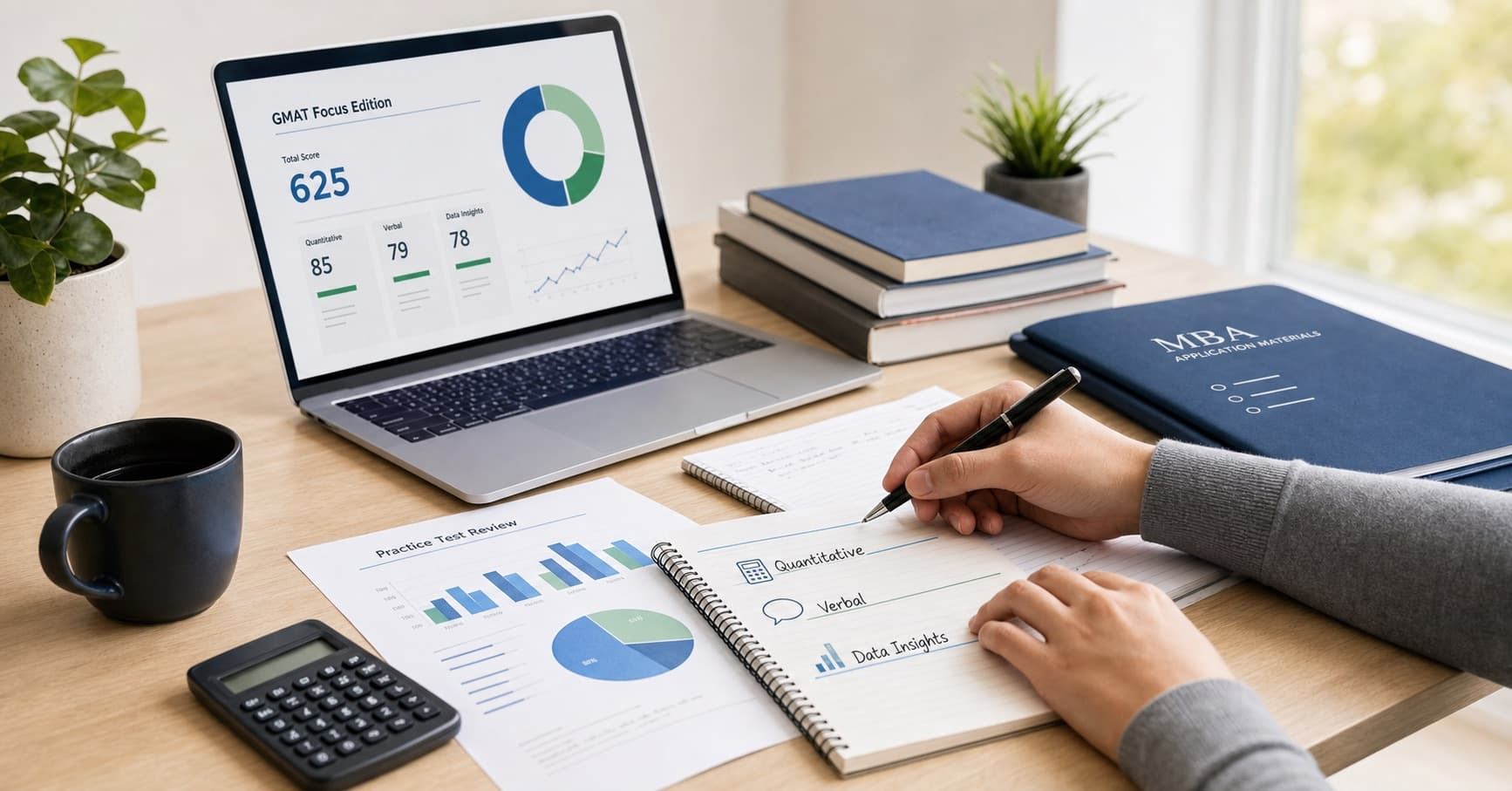
The GMAT Focus Edition 2026 is not just the old GMAT with a shorter timer. It changes what counts, how the exam feels, and where smart MBA applicants should spend their preparation time. If you are applying to business school this year, you need the new GMAT format in your bones before you start grinding practice questions.
And honestly, that is good news. The current exam is cleaner: three sections, no essay, no Sentence Correction, no separate Integrated Reasoning score sitting awkwardly off to the side. But cleaner does not mean casual. Data Insights now affects your total score, Quant still punishes shaky fundamentals, and Verbal has become a pure test of reading and reasoning under pressure.
This guide explains the current GMAT Focus exam in practical terms: the GMAT Focus changes, section timing, scoring, GMAT Focus vs old GMAT differences, and how to build a realistic GMAT 2026 preparation plan. If you want broader study tactics after learning the format, our GMAT study guide pairs well with this breakdown.
What Changed in the GMAT Focus Edition
The easiest way to understand the Focus exam is to stop thinking of it as a miniature version of the old test. It is a redesigned business-school admissions exam. Same broad purpose, different shape.
The old GMAT had four parts: Analytical Writing Assessment, Integrated Reasoning, Quantitative Reasoning, and Verbal Reasoning. The current GMAT has three scored sections: Quantitative Reasoning, Verbal Reasoning, and Data Insights. Each section is 45 minutes. The whole thing runs 2 hours and 15 minutes of testing time, with one optional 10-minute break.
That shorter length sounds friendly until you sit for a timed section and realize there is less room to recover from sloppy pacing. You cannot zone out for five questions, warm up slowly, and hope the essay or a familiar grammar topic saves you. Every section feeds the total score. Every section matters.
The biggest GMAT Focus changes are easy to list, but the implications are bigger than the bullets suggest:
- No essay section. Analytical Writing Assessment is gone from the current format.
- No Sentence Correction. Verbal now focuses on Reading Comprehension and Critical Reasoning.
- Data Insights is scored in the total. It is not a side metric anymore.
- You choose the section order. That makes stamina strategy more personal.
- You can review and edit. You may bookmark questions and change up to three answers per section.
- The score scale is 205-805. Old 200-800 comparisons require care.
So if you studied for the GMAT years ago, or bought an older book from Amazon because it was cheap, pause. A classic GMAT textbook can still help with some Quant and Critical Reasoning fundamentals, but it will not give you the current GMAT focus edition breakdown by itself. You need materials built for the Focus exam.
New GMAT Format Breakdown
The new GMAT format is beautifully simple on paper: three sections, 45 minutes each, 64 total questions. But each section asks for a different kind of mental discipline. Treating them all the same is where a lot of otherwise capable applicants get into trouble.
| Section | Time | Questions | What It Tests |
|---|---|---|---|
| Quantitative Reasoning | 45 minutes | 21 | Arithmetic, algebra, and problem solving without a calculator |
| Verbal Reasoning | 45 minutes | 23 | Reading Comprehension and Critical Reasoning |
| Data Insights | 45 minutes | 20 | Tables, graphs, multi-source data, data sufficiency, and mixed reasoning |
Notice what is missing. There is no Analytical Writing Assessment. There is no Sentence Correction. There is no separate Integrated Reasoning section with a score many applicants half-ignored. The current GMAT Focus Edition syllabus is more compact, and because of that, it is less forgiving of weak areas.
Quantitative Reasoning is all problem solving. Data Sufficiency, once part of Quant on the classic exam, now lives inside Data Insights. That matters because Quant prep for 2026 should not be a giant pile of old Data Sufficiency drills. You still need logic and number sense, obviously, but the question mix changed.
Verbal Reasoning also changed its personality. If you were hoping to memorize grammar rules and harvest points from Sentence Correction, that lane is closed. Verbal is now more about whether you can read dense business-adjacent prose, evaluate arguments, find assumptions, and avoid attractive wrong answers.
Data Insights is the section many students underestimate. It can feel like a spreadsheet, a logic game, and a business memo had a very stressful meeting. You may see Multi-Source Reasoning, Table Analysis, Graphics Interpretation, Two-Part Analysis, and Data Sufficiency. You get an on-screen calculator here, but do not let that make you lazy. The hard part is often deciding what information matters.
GMAT Focus Scoring and Percentiles
GMAT Focus scoring is one of the easiest places to get confused because the numbers look almost familiar. The total score range is 205 to 805, and every total score ends in a 5. That is close enough to the old 200-800 scale to trick people into lazy comparisons. Do not fall for it.
A 705 on the Focus scale is not something you should casually call "basically a 700 old GMAT." Percentiles shifted, the test composition changed, and all three current sections contribute to the total score. When schools, tutors, or applicants discuss GMAT Focus percentiles, the percentile context matters more than the emotional feel of the number.
The three section scores are weighted equally in the total score. That is huge. Under the old format, some applicants treated Integrated Reasoning as a "nice to have" because it did not feed the main 200-800 score. In the current format, Data Insights can lift or drag your total score directly.
This changes how you should read practice-test results. Suppose your Quant is strong and Verbal is decent, but Data Insights is messy. You might be tempted to keep hammering Quant because it feels comfortable and produces that satisfying "I got it right" feeling. Bad idea. Your score ceiling may be sitting inside those awkward chart and table questions.
For target setting, start with your school list. Top MBA programs still care about the GMAT as a signal of academic readiness, but they read it alongside GPA, work experience, recommendations, essays, and interview performance. A strong score helps. It does not carry the entire application on its back. For a broader admissions-test comparison, see our GRE vs GMAT guide.
GMAT Focus vs Old GMAT
The GMAT Focus vs old GMAT question usually comes from one of two people: someone who studied years ago and is returning to the test, or someone who found older prep materials and wants to know whether they are still useful. The answer is: partly.
Old GMAT materials can still teach useful math foundations, Critical Reasoning habits, and Reading Comprehension technique. Algebra did not change its mind because GMAC redesigned the exam. Arguments still have assumptions. Main ideas are still main ideas.
But if your book spends 200 pages on Sentence Correction, gives you an essay template, or treats Integrated Reasoning as a separate minor score, it is not a complete GMAT 2026 preparation resource. Use it carefully, like a toolbox with missing pieces.
| Feature | Old GMAT | Current GMAT Focus |
|---|---|---|
| Total testing time | About 3 hours 7 minutes | 2 hours 15 minutes |
| Sections | Quant, Verbal, Integrated Reasoning, Essay | Quant, Verbal, Data Insights |
| Main score range | 200-800 | 205-805 |
| Sentence Correction | Included | Removed |
| Data skills | Integrated Reasoning, separately scored | Data Insights, part of total score |
In plain English: the old test rewarded a wider mix of endurance, grammar, essay organization, math, and reasoning. The the 2026 Focus format rewards concentrated reasoning, data literacy, and decision-making speed. Less ceremony. More signal.
Need a GMAT Focus Prep Plan That Fits Your Score Goal?
Our GMAT tutors can help you diagnose weak sections, build a Focus-specific study plan, and prepare for the current exam format with targeted practice.
How to Approach Each Section
A good Focus-specific plan does not say "study GMAT" and call it strategy. It separates the three sections, then trains the habits each one demands. That sounds obvious. In practice, many students avoid the section that bruises their ego. Usually Data Insights. Sometimes Verbal.
Quantitative Reasoning
GMAT Focus Edition quantitative reasoning is not advanced math. It is arithmetic, algebra, number properties, rates, ratios, inequalities, word problems, and problem solving under time pressure. No calculator. No mercy for fuzzy fundamentals.
Your goal is not to memorize every possible problem. Your goal is to recognize structures quickly: weighted average, work-rate, percent change, overlapping sets, divisibility, linear equations, and hidden constraints. The best Quant students do less frantic calculation than beginners. They simplify earlier.
Verbal Reasoning
Verbal is now Reading Comprehension and Critical Reasoning. That means you need patience with dense text and discipline with answer choices. The GMAT loves answers that are almost right: too broad, too strong, backwards, outside the scope, or emotionally tempting but logically unsupported.
For Reading Comprehension, read for structure first. What is the author doing? Defining a problem, challenging a theory, comparing explanations, proposing a fix? For Critical Reasoning, name the conclusion, evidence, assumption, and gap before you touch the answers. Slow is smooth at first. Smooth becomes fast.
Data Insights
Data Insights is the signature section of the new GMAT format. It asks whether you can interpret information the way managers actually do: across tables, charts, text, claims, constraints, and tradeoffs. It rewards flexible thinking. It punishes tunnel vision.
Practice all five major Data Insights families: Data Sufficiency, Multi-Source Reasoning, Table Analysis, Graphics Interpretation, and Two-Part Analysis. Do not simply chase harder questions. Build a process: skim the source, identify what the question asks, locate only the needed data, estimate where possible, then calculate only when calculation is truly required.
If you want coaching that focuses on the current question mix, our fast GMAT pass tutoring can help you stop wasting time on outdated drills and build section-specific habits for the Focus exam.
GMAT 2026 Preparation Plan
GMAT 2026 preparation should start with a diagnostic, not a shopping spree. Yes, the official GMAT Focus book, online courses, bootcamps, and question banks can all be useful. But buying resources before you know your weak spots is how people end up with five subscriptions and no plan.
Start with an official practice exam or a high-quality Focus-style diagnostic. Take it under real timing. No pausing, no snacks during the section, no "I basically knew that one." Your baseline score tells you how far you are from your target, and your section breakdown tells you where the work is hiding.
A practical 10-week plan for the current GMAT format might look like this:
- Weeks 1-2: Baseline and foundations. Review arithmetic, algebra, core Critical Reasoning question types, and basic Data Insights formats. Keep an error log from day one.
- Weeks 3-4: Quant and Verbal accuracy. Drill common Quant patterns and Verbal argument structures without obsessing over speed yet. Accuracy first.
- Weeks 5-6: Data Insights buildout. Add tables, graphs, multi-source prompts, and data sufficiency. Learn when to estimate and when to calculate.
- Weeks 7-8: Timed section work. Move from topic practice into full 45-minute sections. Test section orders and track fatigue.
- Weeks 9-10: Full practice exams and refinement. Take complete practice tests, review every miss, and reduce avoidable errors. Your job is now consistency.
Working full-time? Stretch the plan to 12-16 weeks. There is no prize for rushing into a retake with the same habits that created your first score. A busy applicant studying 8-10 hours a week can absolutely improve, but the schedule has to be honest. Morning Quant drills before work, Verbal review at lunch, Data Insights on two weeknights, full practice on Saturday. Boring? A little. Effective? Very.
If your score is stuck or your deadline is close, look at structured help early. Our GMAT exam assistance services and GMAT tutoring program are built for applicants who need targeted support instead of more generic advice.
Test-Day Features You Should Use
One underrated part of the current GMAT exam is that the exam gives you more control than the old GMAT in a few useful ways. Control does not automatically become advantage, though. You need to practice using these features before test day.
Choose Your Section Order
You can take Quantitative Reasoning, Verbal Reasoning, and Data Insights in the order you prefer. That is not a tiny detail. Some students should start with their strongest section to build confidence. Others should attack their hardest section first while fresh. You will not know which camp you are in until you test it.
Try at least two section orders during practice exams. Track not just the score, but how you feel in section three. If Data Insights makes your brain feel scrambled after Verbal, maybe it belongs earlier. If Quant anxiety lingers and poisons the rest of the test, maybe you should start there and get it done.
Bookmark, Review, and Edit
The current exam lets you bookmark questions and change up to three answers per section. That sounds generous. It can also become a trap if you turn every hard question into a dramatic reunion at the end of the section.
Build a rule. For example: if you are completely lost, make a reasonable guess and move on without promising to return. If you have two answer choices and know exactly what would resolve the question, bookmark it. That kind of discipline keeps the review feature from becoming a time sink.
Send Scores After You See Them
Another candidate-friendly change: you can send free score reports after seeing your score, rather than choosing schools before the exam. That reduces some test-day stress. Still, make your school list ahead of time and understand each program's reporting deadline. Admissions calendars have a way of getting rude at the worst possible moment.
Common GMAT Focus Mistakes
Most GMAT Focus mistakes are not mysterious. They are ordinary prep errors wearing nicer clothes. You can avoid a lot of pain by catching them early.
Using old materials without filtering them. Classic GMAT resources are not worthless, but they are not the whole map. Skip essay prep. Do not overinvest in Sentence Correction. Make sure your Data Insights practice matches the current exam.
Ignoring Data Insights until the final month. This is probably the biggest new-format mistake. Data Insights is not a garnish. It feeds your total score, and it takes time to develop calm, efficient habits with messy information.
Practicing questions but not reviewing them. Doing 500 problems and barely reviewing misses feels productive. It is mostly noise. Your error log should name the cause: concept gap, reading mistake, timing panic, wrong assumption, calculation slip, or answer-choice trap.
Choosing section order on vibes. Test different orders. Your preferred order should be based on practice data, not a motivational quote or something someone on Reddit swore worked for them.
Confusing speed with rushing. The GMAT Focus Edition rewards efficient reasoning, not frantic clicking. If you are constantly rereading, recalculating, and changing answers late, the issue is usually process, not raw speed.
Comparing scores incorrectly. Again, GMAT Focus scoring uses the 205-805 scale. Schools understand the new score range, but applicants often panic because a number feels lower or higher than expected. Read percentiles and school guidance.
If you are still deciding between graduate admissions exams, revisit our GRE vs GMAT comparison. If you know the GMAT is your test, pair this format guide with our complete GMAT study plan and our broader guide on how to improve your exam score.
The current GMAT exam is more streamlined than the old exam, but it is not lightweight. Learn the format, respect Data Insights, choose your section order deliberately, and prepare with current materials. Do that, and the new GMAT format becomes much less intimidating. Still challenging, yes. But knowable.
Frequently Asked Questions
What is the current GMAT Focus exam?
The current GMAT Focus exam is the format used for business school admissions. It has three 45-minute sections: Quantitative Reasoning, Verbal Reasoning, and Data Insights. The exam lasts 2 hours and 15 minutes, includes 64 scored questions, and uses a total score scale from 205 to 805.
Is the GMAT Focus Edition replacing the old GMAT?
Yes. The older GMAT format with Analytical Writing Assessment, Integrated Reasoning, Quantitative Reasoning, and Verbal Reasoning has been replaced by the shorter current GMAT exam. For 2026 applicants, GMAT Focus is the format to prepare for unless a school gives highly unusual legacy-score guidance.
How long is the GMAT Focus Edition?
The GMAT Focus Edition is 2 hours and 15 minutes of testing time, plus one optional 10-minute break. Each of the three sections lasts 45 minutes. The shorter length is one of the biggest GMAT Focus changes compared with the previous exam.
What are the three sections of the GMAT Focus Edition?
The three sections are Quantitative Reasoning, Verbal Reasoning, and Data Insights. Quant has 21 questions, Verbal has 23 questions, and Data Insights has 20 questions. You can choose the section order that fits your strengths and stamina.
What is the GMAT Focus Edition score range?
The total GMAT Focus score range is 205 to 805, with all total scores ending in 5. The score is based on all three sections, and the sections are weighted equally toward the total score.
Is the GMAT Focus Edition harder than the old GMAT?
It is not simply harder or easier. It is shorter and more concentrated. Sentence Correction and the essay are gone, but Data Insights now matters directly for your total score. Students who are comfortable with charts, tables, and business-style reasoning may find it more natural; students who relied on grammar-heavy Sentence Correction may need to adjust.
Can I use a calculator on the GMAT Focus Edition?
You do not get a calculator for Quantitative Reasoning. You do get an on-screen calculator for Data Insights. That split matters, because Quant preparation still requires arithmetic fluency, estimation, and clean algebra without calculator dependence.
How should I prepare for GMAT Focus in 2026?
Start with an official diagnostic, learn the new GMAT format, and build a plan around the three scored sections. Spend early weeks on Quant and Verbal foundations, then add Data Insights drills, full timed sections, and official practice exams. Review every mistake by question type, not just by right or wrong answer.
Do business schools accept GMAT Focus scores?
Yes. Business schools accept the current GMAT exam for MBA and business master's admissions. Always check each target school's admissions page for score reporting details, but for 2026 applications, the Focus-style GMAT is the standard format.
What GMAT Focus score is competitive for top MBA programs?
Competitive scores vary by school, applicant profile, and program. Because the scale changed from 200-800 to 205-805, do not compare old and new scores casually. Use school class profiles, official concordance information when needed, and percentile context to decide whether your score is strong enough for your target list.