
Want to get into nursing school? The HESI A2 exam stands between you and your dream program. And honestly? It's intimidating.
Thousands of nursing hopefuls take the HESI A2 every year, and many walk in unprepared for what they'll face. The exam covers everything from anatomy and physiology to reading comprehension and math - testing not just what you know, but how quickly you can apply it under pressure.
Here's the thing about HESI A2 study tips: most advice online is generic and unhelpful. "Study hard" doesn't cut it when you're competing against hundreds of applicants for limited nursing school spots. You need specific strategies that actually work - the kind that help students score 85%+ and get into their first- choice programs.
This guide breaks down exactly how to pass the HESI A2 exam, from understanding what's tested to section-specific strategies that maximize your score. Whether you're retaking the exam after a disappointing first attempt or preparing for your initial try, these HESI A2 study tips will transform your preparation approach.
What is the HESI A2 Exam?
The HESI A2 (Health Education Systems, Inc. Admission Assessment) is the entrance exam used by over 90% of nursing schools to evaluate applicants. It measures your academic readiness for nursing programs by testing skills you'll need throughout your nursing education and career.
Unlike the SAT or ACT, the HESI A2 focuses specifically on nursing-relevant subjects. You're not just proving you can learn - you're proving you can handle the academic rigor of nursing school, where A&P, pharmacology calculations, and medical terminology will become daily challenges.
Why Your HESI A2 Score Matters
Nursing programs are competitive. Really competitive. Many schools receive 3-5 times more qualified applicants than available spots. Your HESI A2 score becomes a key differentiator when GPA and prerequisite grades are similar among applicants.
- Minimum requirements: Most schools require 75-80% composite scores
- Competitive scores: 85%+ significantly improves admission chances
- Scholarship opportunities: Some programs award scholarships based on HESI A2 scores
- Section minimums: Many schools require minimum scores in specific sections (commonly Math and Reading)
Bottom line: a strong HESI A2 score can compensate for a lower GPA, but a weak score can sink an otherwise strong application. Take preparation seriously.
HESI A2 Exam Sections Breakdown
The full HESI A2 has eight academic sections, but most nursing schools only require 4-6 of them. Before you start studying, find out exactly which sections your target schools require - this determines where to focus your preparation.
Core Sections (Most Schools Require These)
Mathematics (50 questions, 50 minutes)
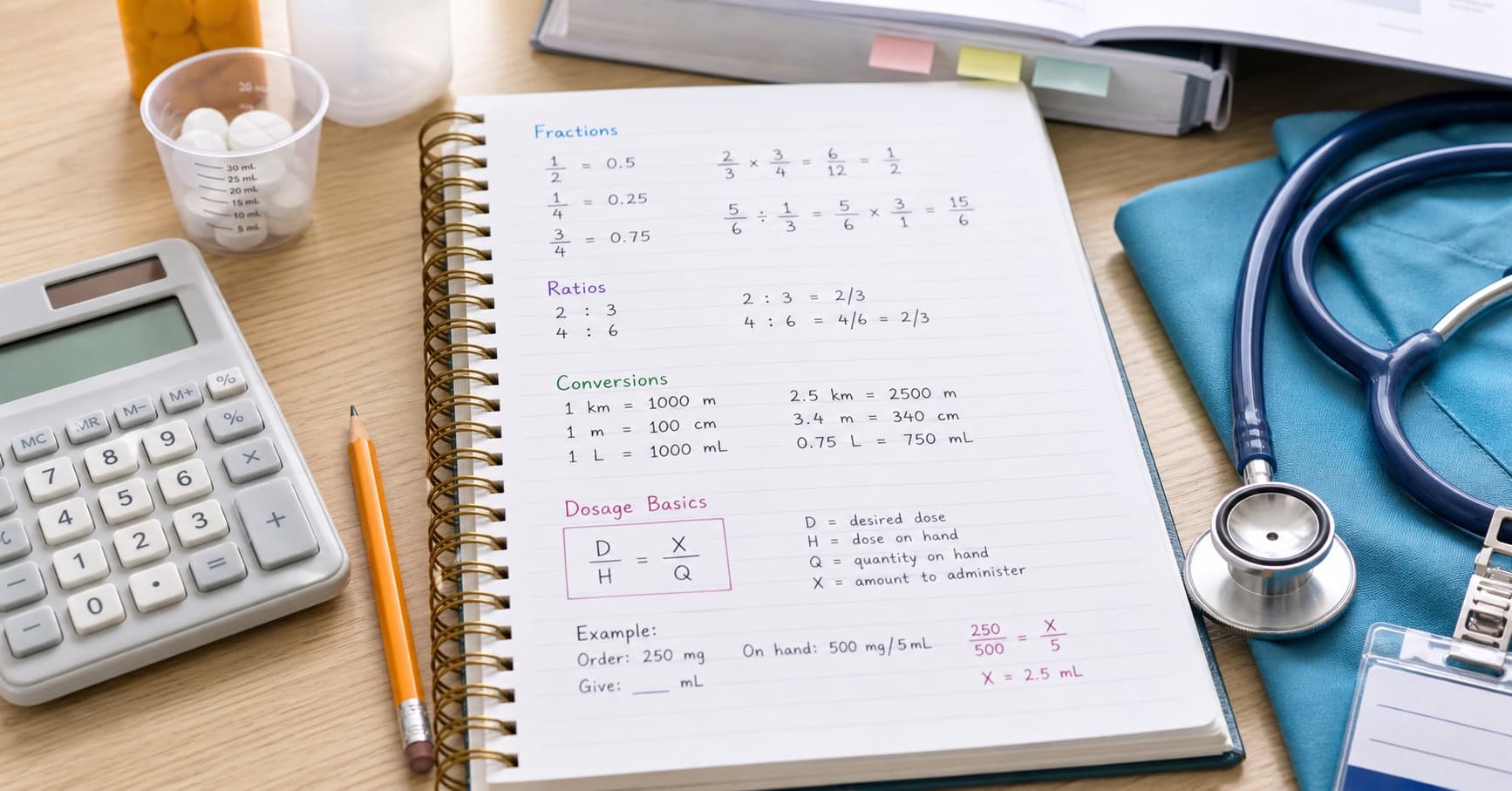
Tests basic math, fractions, decimals, ratios, proportions, and dosage calculations. No advanced algebra or calculus. The catch? Most questions require manual calculation - the on-screen calculator is basic.
Key topics: Conversions (metric/household), ratio & proportion, percentages, basic geometry
Reading Comprehension (47 questions, 60 minutes)
Presents passages and tests your ability to identify main ideas, make inferences, and understand context. Passages are often science or healthcare related - similar to what you'll read in nursing school.
Key skills: Main idea identification, inference, vocabulary in context, author's purpose
Vocabulary & General Knowledge (50 questions, 50 minutes)
Tests medical terminology, general vocabulary, and word meanings in context. Many terms appear frequently in nursing education - knowing them now gives you a head start.
Key areas: Medical prefixes/suffixes/roots, commonly confused words, healthcare terminology
Grammar (50 questions, 50 minutes)
Tests grammar rules, sentence structure, and punctuation. Nursing requires clear documentation - grammar skills matter more than you might think.
Key topics: Subject-verb agreement, punctuation, sentence structure, commonly misused words
Science Sections (Required by Many Programs)
- Anatomy & Physiology (25 questions, 25 min): The hardest section for most students. Tests body systems, organ functions, and physiological processes.
- Biology (25 questions, 25 min): Covers cell biology, genetics, metabolism, and basic biological concepts.
- Chemistry (25 questions, 25 min): Tests atomic structure, chemical reactions, solutions, and basic organic chemistry.
- Physics (25 questions, 25 min): Covers mechanics, energy, waves, and electricity basics. Least commonly required section.
Is the HESI Exam Hard?
The honest answer? It depends. The HESI A2 isn't designed to trick you or test obscure knowledge. It measures whether you have the academic foundation for nursing school success. For students who've recently completed prerequisites, it's manageable. For those returning to school after years away, it can be challenging.
Here's what makes the HESI A2 difficult for many students:
- Breadth of content: Covering 4-6 different subjects requires diverse preparation
- Time pressure: Questions per minute ratio is tight, especially in science sections
- Application-based questions: You can't just memorize - you need to apply concepts
- A&P complexity: Anatomy & Physiology trips up students who haven't taken the course recently
- Limited calculator use: Math requires mental calculation skills many students have lost
HESI A2 Difficulty by Section (Student Ratings)
- Anatomy & Physiology: Most difficult - requires solid foundation
- Chemistry: Challenging if you haven't taken chem recently
- Math: Moderate - harder without calculator practice
- Reading Comprehension: Moderate - time management is key
- Vocabulary: Easier with medical terminology study
- Grammar: Generally easiest for native English speakers
The good news? With proper HESI A2 preparation, the exam is absolutely passable. Students who follow structured study plans and take adequate practice tests consistently score above program minimums. It's not about being naturally gifted - it's about being prepared.
Proven HESI A2 Study Tips
Generic study advice won't get you into nursing school. These HESI A2 study tips are specific, actionable strategies that successful students use to maximize their scores. Follow them systematically, and you'll be well-positioned to pass.
Tip #1: Take a Diagnostic Test First (Before Studying)
Don't start studying until you know where you stand. Take a full HESI A2 practice test before opening any study materials. Your results will reveal exactly which sections need the most attention and prevent wasting time on areas you already know.
Score 80%+ in a section? Light review only. Score below 70%? That's where you focus intensive study. Many students make the mistake of studying their strongest subjects because it feels productive - but your score improves most where you're currently weakest.
Tip #2: Master Math Without a Calculator
The on-screen calculator is basic - four functions only. Students who rely on graphing calculators or phone apps struggle with HESI A2 math. Practice these skills manually:
- Fraction operations (adding, subtracting, multiplying, dividing)
- Decimal and percentage conversions
- Metric to household measurement conversions
- Ratio and proportion problems
- Basic dosage calculations
Practice at least 30 minutes daily with paper-and-pencil math. Yes, it feels old-school. But nursing dosage calculations often require manual verification anyway - this skill serves you beyond the exam.
Tip #3: Build Medical Vocabulary Systematically
Rather than memorizing random word lists, learn medical word construction. If you understand that "cardio" means heart, "myo" means muscle, and "-itis" means inflammation, you can decode "myocarditis" (heart muscle inflammation) without memorizing the specific term.
High-Yield Medical Prefixes, Roots, and Suffixes
- Prefixes: hypo-, hyper-, anti-, pre-, post-, peri-, endo-, exo-
- Roots: cardio, neuro, hepat, nephr, pulm, gastr, derm
- Suffixes: -itis, -ectomy, -osis, -pathy, -scopy, -gram
Learning 50 word parts helps you decode hundreds of medical terms - much more efficient than memorizing individual definitions.
Tip #4: Use Active Reading Strategies
HESI A2 reading passages are dense and time-limited. Passive reading won't cut it. Use these active strategies:
- Read questions first: Know what you're looking for before reading the passage
- Identify main idea immediately: Usually in the first or last paragraph
- Mark key information mentally: Names, dates, cause-effect relationships
- Don't over-analyze: The answer is in the text - avoid reading into things
Practice with science and healthcare articles to simulate actual HESI A2 passage types. Medical journal abstracts, health education materials, and nursing textbook chapters are excellent practice sources.
HESI A2 Study Schedule
How long to study for HESI A2 depends on your starting point. Use your diagnostic test scores to determine which timeline fits your situation.
4-Week Intensive Schedule (Strong Academic Background)
Who this is for: Recent prerequisite completion, diagnostic scores 70%+ in most sections, 3+ hours daily study time available.
- Week 1: Content review of weakest sections + daily practice tests
- Week 2: Deep dive into A&P and science sections + vocabulary building
- Week 3: Full practice tests + targeted review of missed questions
- Week 4: Light review, practice tests, mental preparation
8-Week Standard Schedule (Average Preparation Needs)
Who this is for: Some time since prerequisites, diagnostic scores 50-70% in most sections, 2 hours daily study time.
- Weeks 1-2: Foundation building in Math and A&P
- Weeks 3-4: Reading, Vocabulary, and Grammar intensive
- Weeks 5-6: Science sections (if required) + practice tests
- Weeks 7-8: Full practice tests + weak area reinforcement
12-Week Extended Schedule (Significant Review Needed)
Who this is for: Years since academic coursework, diagnostic scores below 50% in multiple sections, 1-2 hours daily study time.
- Weeks 1-4: Fundamental concept review across all sections
- Weeks 5-8: Intensive content mastery + daily practice questions
- Weeks 9-10: Full practice tests + targeted remediation
- Weeks 11-12: Final review + confidence building
Best HESI A2 Practice Test Resources
HESI A2 practice tests are essential - they're the single best predictor of exam performance. But not all practice tests are equal. Some are too easy, others test content that isn't on the real exam. Here's what actually works.
Official and Recommended Resources
- HESI Admission Assessment Exam Review (Elsevier, $30-40): The official study guide from HESI's publisher. Includes practice questions that closely match actual exam format and difficulty. Essential purchase.
- Elsevier Adaptive Quizzing ($50-70): Online platform with thousands of questions. Adapts to your level and tracks progress. Worth the investment if you need extensive practice.
- Pocket Prep HESI A2 App (Free + Premium): Mobile practice questions with explanations. Great for studying during commutes or breaks. Premium version unlocks full question bank.
- Mometrix HESI A2 Study Guide ($40-50): Comprehensive content review with practice tests. Good alternative to the official guide with detailed explanations.
Free HESI A2 Practice Test Options
- Union Test Prep: Free practice tests for all HESI A2 sections. Quality varies but good for basic practice.
- Test-Guide.com: Free online practice questions with explanations. Helpful for vocabulary and grammar review.
- Khan Academy (for Math and Science): Not HESI-specific, but excellent for foundational content review. Completely free.
- YouTube HESI A2 Reviews: Many nursing students share study tips and content reviews. Good supplement, not replacement for structured practice.
Struggling to fit HESI A2 practice into your busy schedule? Our HESI exam assistance services provide personalized study plans and expert guidance that accelerates your preparation timeline. Sometimes working with experts who know exactly what's tested makes all the difference.
Section-by-Section Study Strategies
Each HESI A2 section requires different preparation approaches. Here's how to maximize your score in each area.
HESI A2 Math Strategy
- Memorize conversion factors: Know metric to household conversions cold (teaspoons to mL, pounds to kg)
- Master ratio and proportion: This appears in 50%+ of math questions
- Practice without a calculator: Build mental math speed
- Focus on word problems: Most questions are scenario-based, not pure calculation
HESI A2 Reading Comprehension Strategy
- Practice passage types: Healthcare articles, scientific studies, instructional texts
- Time yourself: About 1 minute per question including reading time
- Answer what's asked: Don't infer beyond the text
- Eliminate wrong answers: Usually 2 answers are obviously wrong
HESI A2 Anatomy & Physiology Strategy
- Focus on function over anatomy: Understand what organs DO, not just where they are
- Learn system relationships: How cardiovascular and respiratory systems interact, etc.
- Use visual aids: Diagrams help remember organ locations and pathways
- Master homeostasis: Many questions test feedback loops and regulation
HESI A2 Grammar Strategy
- Review subject-verb agreement: Common trap questions involve compound subjects
- Learn comma rules: Comma placement questions appear frequently
- Practice commonly confused words: Their/there/ they're, affect/effect, accept/except
- Read answers aloud mentally: Incorrect grammar often "sounds wrong"
HESI A2 Test Day Tips
Your preparation culminates on test day. Don't let poor planning sabotage weeks of studying. These practical tips ensure you perform at your best.
The Night Before
- Don't cram: Light review only - your brain needs rest to perform
- Prepare everything: ID, confirmation email, directions, snacks
- Get 7-8 hours of sleep: Fatigue tanks test performance more than incomplete studying
- Know the testing center location: Do a practice drive if unfamiliar
Day of the Exam
- Eat a balanced breakfast: Protein and complex carbs for sustained energy
- Arrive 15-20 minutes early: Rushing increases anxiety and mistakes
- Bring approved items only: Most testing centers don't allow phones, bags, or notes
- Use bathroom before starting: Breaks eat into your limited time
During the Exam
- Read each question carefully: Many mistakes come from misreading
- Watch your pace: Check the clock after every 10 questions
- Don't change answers unless certain: First instinct is usually correct
- Answer every question: No penalty for guessing - never leave blanks
- Take deep breaths if stressed: Panic wastes time and clouds thinking
Proper HESI A2 preparation gives you confidence on test day. If you've followed these study tips, taken multiple practice tests, and addressed your weak areas, you're ready. Trust your preparation and perform.
Need additional support before your exam? Our Fast HESI A2 Pass tutoring provides last-minute intensive preparation for students who need to maximize their scores quickly. Expert guidance can make the difference between a good score and a great one.
Frequently Asked Questions
What is a good HESI A2 score?
A good HESI A2 score depends on your nursing school's requirements. Most programs require a minimum composite score of 75-80%, though competitive programs may want 85% or higher. Some schools set minimum scores for individual sections (like 75% in Math and Reading). The national average is around 77%, so scoring above 80% puts you in a strong position for most nursing programs. Check your specific school's requirements before testing.
How many questions are on the HESI A2 exam?
The full HESI A2 exam has approximately 326 questions across all sections, but most nursing schools only require certain sections - typically between 50-100 questions. The most commonly required sections are Math (50 questions), Reading Comprehension (47 questions), Vocabulary (50 questions), Grammar (50 questions), and Anatomy & Physiology (25 questions). Biology (25 questions), Chemistry (25 questions), and Physics (25 questions) may be required for some programs. Check with your school for exact requirements.
How long is the HESI A2 exam?
The HESI A2 exam takes 4-5 hours to complete all sections, but most students finish their required sections in 2-4 hours. Each section has a time limit: Math (50 minutes), Reading (60 minutes), Vocabulary (50 minutes), Grammar (50 minutes), and science sections (25 minutes each). There's no penalty for finishing early, and you can't go back to previous sections once completed. Plan for breaks between sections to maintain focus.
How to pass the HESI A2 exam?
To pass the HESI A2 exam: (1) Know your school's required sections and minimum scores. (2) Take a diagnostic test to identify weak areas. (3) Focus 70% of study time on your weakest sections. (4) Use official HESI study materials and practice tests that mirror actual exam format. (5) Master basic math skills without a calculator since calculators aren't allowed on most sections. (6) Study Anatomy & Physiology thoroughly - it's the hardest section for most students. (7) Practice reading comprehension with science-based passages. (8) Take at least 3-5 full practice tests before your exam date.
Can I use a calculator on the HESI A2?
The HESI A2 provides an on-screen calculator for the Math section only - you cannot bring your own calculator. The calculator is a basic four-function calculator, so you need to understand the math concepts rather than relying on complex calculator functions. For conversions, fractions, and ratios, you'll need to work through problems manually. Practice solving math problems with only a basic calculator or by hand to prepare.
How long should I study for the HESI A2?
Study time depends on your academic background. Students with strong science and math foundations typically need 4-6 weeks of preparation (2-3 hours daily). Those needing to review basic concepts should plan for 8-12 weeks. If you're taking Anatomy & Physiology or Chemistry sections and haven't taken these courses recently, add 2-4 extra weeks. Most successful students study 60-100 hours total before testing.
What is the difference between HESI A1 and HESI A2?
The HESI A1 and HESI A2 are actually the same exam - 'A2' just stands for 'Admission Assessment' version 2. Some schools still use the older 'A1' terminology, but they refer to the same current HESI entrance exam. The exam is also sometimes called the HESI Admission Assessment, HESI Entrance Exam, or simply the 'HESI.' Don't be confused by the different names - check with your school for which sections they require.
How many times can you take the HESI A2?
HESI retake policies are set by individual nursing schools, not by the testing company. Most schools allow 2-3 attempts per year with mandatory waiting periods (typically 30-60 days between attempts). Some schools limit total lifetime attempts to 3-5 tries. Each retake usually costs $40-100 in testing fees. Check your specific school's retake policy before your first attempt - failing multiple times can hurt your application.
Is the HESI A2 harder the second time?
No, the HESI A2 isn't intentionally harder the second time. However, the exam pulls from a large question bank, so you'll see different questions on each attempt. Some students find the second attempt easier because they're familiar with the format and timing, while others struggle with different question variations. The difficulty level is designed to be consistent across all attempts. Focus on addressing your weak areas rather than worrying about exam difficulty changes.
What should I study for the HESI A2 Anatomy and Physiology section?
Focus on these high-yield A&P topics: body systems (cardiovascular, respiratory, nervous, digestive, skeletal, muscular), cell structure and function, homeostasis, anatomical terminology and body planes, major organs and their functions, and basic pathophysiology. The HESI A2 A&P section tests conceptual understanding, not detailed memorization. Use diagrams to learn organ locations and systems relationships. Practice questions that connect anatomy to physiological function - this is how the exam tests your knowledge.
Ready to Ace the HESI A2?
Stop guessing what to study. Our AI-powered Fast HESI A2 Pass tutoring identifies your exact weak areas and creates personalized practice that focuses where you need it most. Join hundreds of nursing students who have improved their scores and gotten into their dream programs with our proven HESI exam services.