So you want to get your PMP certification. Smart move. It's one of the most recognized credentials in project management, and it can seriously boost your career. But here's the thing - the PMP exam is no joke.
About 30-40% of first-time test takers don't pass. That's a lot of people spending $555 (or $405 for PMI members) only to face the exam again. Not to mention the months of studying that didn't quite get them there.
The difference between passing and failing usually comes down to one thing: having a solid PMP exam study plan. Not just "I'll study when I have time" but an actual, structured approach that covers everything you need to know - in the right order, with the right resources.
This guide gives you exactly that. We'll break down how to pass the PMP on your first try, including realistic study schedules, the best resources, and strategies that actually work. Whether you're a seasoned project manager or relatively new to the field, this PMP certification study guide will help you build a preparation plan that works.
What is the PMP Exam?
The Project Management Professional (PMP) certification is offered by the Project Management Institute (PMI). It's the gold standard credential for project managers worldwide - over 1 million people hold the certification, and it's recognized across industries from IT to construction to healthcare.
But here's what a lot of people don't realize: the PMP exam isn't just about memorizing processes and knowledge areas. That's the old-school approach. The current exam focuses heavily on real-world application - how would you actually handle situations as a project manager? What's the "PMI way" of doing things?
The PMP Mindset
Here's something crucial: the PMP exam tests how PMI thinks you should manage projects, which isn't always how things work in the real world. You need to answer questions from PMI's perspective, not based on what your company does or what seems practical in your experience.
- Stakeholder engagement is always important - even when it feels like overkill
- Documentation and planning matter - but so does flexibility and adaptation
- Servant leadership is the default - you empower teams rather than direct them
- Change is managed, not resisted - through proper change control processes
PMP Exam Format for 2026
The PMP exam format changed significantly in January 2021, and those changes continue into 2026. If you're using study materials from before 2021, throw them out. Seriously. The exam is fundamentally different now.
Current PMP Exam Structure:
- 180 questions (175 scored, 5 unscored pretest questions)
- 230 minutes (3 hours 50 minutes) of testing time
- Two optional 10-minute breaks after questions 60 and 120
- Mixed question formats including multiple choice, matching, hotspot, and fill-in-the-blank
The Three Domains
The exam covers three domain areas, and understanding their weight is essential for your PMP exam study plan:
- People (42%) - Managing teams, resolving conflict, supporting team performance, empowering team members, leading and developing the team
- Process (50%) - Planning, executing, monitoring and controlling project work, managing scope, schedule, cost, quality, and resources
- Business Environment (8%) - Compliance, benefits delivery, organizational change, project benefits realization
PMP Eligibility Requirements
Before you dive into creating your PMP certification study plan, make sure you meet the eligibility requirements. PMI has specific criteria, and your application can be audited.
Education and Experience Requirements
You need one of these combinations:
- Four-year degree + 3 years (36 months) leading projects + 35 hours of PM education
- High school diploma or associate's degree + 5 years (60 months) leading projects + 35 hours of PM education
The "leading projects" experience doesn't mean you needed the title "Project Manager." If you directed and led project tasks, managed scope, schedule, cost, or resources, and delivered project outcomes - that counts. Think broadly about your experience.
The 35-Hour Education Requirement
This is non-negotiable. You must complete 35 contact hours of project management education from a PMI-approved provider (REP or ATP). Options include:
- Online courses: Typically $100-400, self-paced
- Boot camps: $1,500-3,000, intensive 3-5 day programs
- University courses: May be covered if you took PM classes
- Employer-provided training: Check if your company offers PMI-recognized training
How Long to Study for the PMP Exam
This is one of the most common questions, and the honest answer is: it depends. But let me give you realistic ranges based on thousands of PMP candidates' experiences.
Typical Study Timelines
- Experienced PM (5+ years): 6-8 weeks, 15 hours/week (~100 hours total)
- Moderate experience (2-5 years): 8-12 weeks, 15-20 hours/week (~150 hours total)
- Less experience or career changers: 12-16 weeks, 15-20 hours/week (~200+ hours total)
Here's the thing though - these are study hours, not just time with books open while you scroll your phone. Quality matters more than quantity. Someone who studies intensely for 100 hours will likely outperform someone who half-studies for 200 hours.
Building Your Study Schedule
Consistency is everything. It's better to study 2 hours daily than to binge 10 hours on weekends. Your brain needs time to process and retain information.
A realistic daily breakdown for working professionals:
- Weekdays: 1-2 hours (early morning or after work)
- Weekends: 3-4 hours per day
- Weekly total: 11-18 hours
Don't underestimate the value of breaks. Studying fatigued is counterproductive. Take one full day off per week if you can.
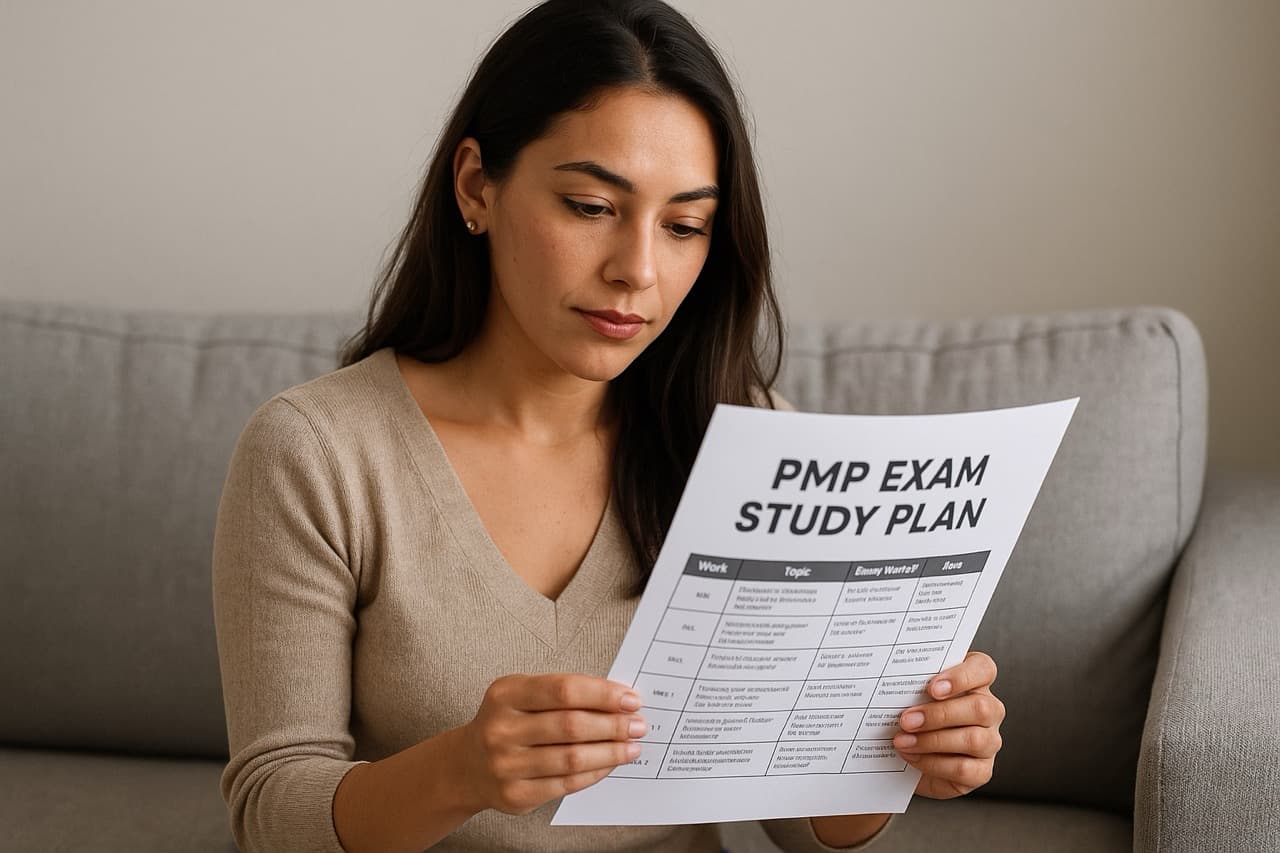
Complete PMP Study Plan Template
Here's a proven 10-week PMP exam study plan that balances content coverage with practice. Adjust the timeline based on your experience level and diagnostic test results.
Weeks 1-2: Foundation Building
- Complete your 35-hour course (if not done already)
- Read the PMBOK Guide once - don't memorize, just understand the structure
- Take a diagnostic practice exam
- Review the Exam Content Outline (ECO) from PMI
- Set up your study schedule and environment
Weeks 3-4: People Domain Deep Dive
- Study team management, conflict resolution, motivation theories
- Focus on servant leadership and emotional intelligence
- Review communication management and stakeholder engagement
- Complete 50-100 practice questions on People domain
Weeks 5-7: Process Domain (The Big One)
- Week 5: Initiating and Planning processes
- Week 6: Executing and Monitoring & Controlling
- Week 7: Closing processes, change management, risk management
- Take a full practice exam at end of Week 7
Week 8: Agile and Hybrid Focus
- Read the Agile Practice Guide thoroughly
- Understand Scrum roles, events, and artifacts
- Study Kanban principles and when to use hybrid approaches
- Complete 100+ agile-focused practice questions
Weeks 9-10: Practice and Polish
- Take 2-3 full-length practice exams (aim for 75%+ consistently)
- Review wrong answers - understand WHY the correct answer is correct
- Focus on weak areas identified by practice exams
- Light review in final 2-3 days - don't cram
If you're struggling with any part of this PMP exam study plan, our PMP tutoring services can help you work through difficult concepts and develop personalized strategies.
Best PMP Study Resources
You don't need every resource out there - in fact, too many resources can be counterproductive. Here's what actually works for the current PMP exam:
Essential Resources
- PMBOK Guide 7th Edition: The foundation. You don't need to memorize it, but you need to understand the principles and performance domains.
- Agile Practice Guide: Free with PMI membership. Covers the agile content that's half the exam.
- PMI Exam Content Outline (ECO): Free from PMI's website. This tells you exactly what's on the exam.
- A quality 35-hour course: Andrew Ramdayal, Joseph Phillips, or Ricardo Vargas are popular instructors.
Practice Exams (Critical)
- PMI Study Hall: Official PMI practice questions. The interface matches the real exam. Worth the $75 subscription.
- Prepcast PMP Simulator: 1,800+ questions with detailed explanations. Highly realistic.
- PMBOK Practice Exam: Included in some study guides. Good for content review.
Supplemental Resources
- YouTube: Ricardo Vargas, Aileen Ellis, and Praizion for free explanations
- Flashcard apps: Brainscape PMP deck for mobile study
- Study groups: Reddit's r/pmp community shares tips and experiences
PMP Exam Strategies That Work
Beyond knowing the content, you need strategies for actually taking the exam. The PMP isn't just a test of knowledge - it's a test of application and judgment.
Answering Strategy
- Read the question twice: Many questions have subtle details that change the answer. What phase are you in? What's already been done?
- Eliminate obviously wrong answers first: You can usually remove 1-2 choices quickly. This improves your odds on tough questions.
- Think "What Would PMI Do?": Not what your company does, not what seems practical - what does PMI say is the right approach?
- Look for process-oriented answers: PMI favors structured approaches. "Check the plan," "Follow the process," "Consult stakeholders" are often correct themes.
Time Management During the Exam
You have about 76 seconds per question. That sounds tight, but many questions take 30-45 seconds. Here's how to manage your time:
- Don't get stuck: If a question is taking more than 2 minutes, mark it and move on
- Take both breaks: Even if you feel fine, the breaks help reset your focus
- Track your pace: At question 60, you should have ~150 minutes left. At question 120, ~76 minutes.
- First pass, second pass: Answer what you know, then return to marked questions
Common Traps to Avoid
- Assuming based on your experience: Real world ≠ PMI world. Answer based on PMI methodology.
- Choosing the first "right" answer: Read all options. There may be a "more right" answer.
- Overthinking simple questions: Not every question is a trick. Sometimes the obvious answer is correct.
- Changing answers without good reason: Your first instinct is usually right. Only change if you have a clear reason.
PMP Test Day Tips
You've put in the work. Now it's time to execute. Here's how to set yourself up for success on exam day.
The Day Before
- Light review only: Don't cram. Review flashcards or key formulas, but nothing heavy.
- Prepare everything: ID, test center confirmation, snacks for break (if test center)
- Get good sleep: Aim for 7-8 hours. The exam requires sustained focus.
- Test your setup: If taking online, verify your computer, webcam, and internet work
Exam Day Morning
- Eat a good breakfast: Protein and complex carbs. Avoid heavy, greasy food.
- Arrive early: 30 minutes for test centers. Log in 15 minutes early for online.
- Use the restroom: Before you start. The breaks are short.
- Stay calm: Nervousness is normal. Take deep breaths. Trust your preparation.
During the Exam
- Start with a brain dump: Use your scratch/whiteboard to write down key formulas you might forget
- Stay hydrated: Small sips of water. Avoid too much - you can't pause for restroom breaks
- Don't panic over hard questions: Everyone gets them. Mark and move on.
- Maintain perspective: You can miss 30-40% of questions and still pass
Remember: the exam is designed to be challenging. If you've followed a structured PMP exam study plan, taken multiple practice exams, and consistently scored 75%+, you're ready. Trust the process.
Need additional support before your exam? Our PMP preparation tutoring can help you master difficult concepts, review your weak areas, and build confidence for test day. Or if you're looking for more comprehensive support, explore our PMP exam help services.
Frequently Asked Questions
How long should I study for the PMP exam?
Most successful PMP candidates study for 8-12 weeks, dedicating 15-20 hours per week. This adds up to roughly 150-200 hours of total study time. However, your timeline depends on your project management experience and familiarity with PMI methodology. Candidates with extensive PM experience may need only 6-8 weeks, while those newer to formal project management should plan for 12-16 weeks. Take a diagnostic test early - if you score below 60%, plan for the longer timeline.
How to pass the PMP exam on the first try?
To pass the PMP on your first attempt: (1) Create a structured study plan and stick to it - consistency beats cramming. (2) Complete a 35-hour contact hour course from a PMI-approved provider. (3) Read the PMBOK Guide at least once, focusing on understanding concepts over memorization. (4) Take multiple full-length practice exams and aim for 75%+ before your test date. (5) Focus heavily on agile and hybrid approaches - they make up about 50% of the exam. (6) Master the 'PMI mindset' by understanding why correct answers are correct, not just which ones are right.
Is the PMBOK enough to pass the PMP?
No, the PMBOK Guide alone is not enough to pass the PMP exam. While it's a foundational resource, the current PMP exam heavily emphasizes agile and hybrid methodologies, which aren't covered extensively in the PMBOK. You also need the Agile Practice Guide, understanding of the Exam Content Outline (ECO), and practice with situational questions. The PMBOK provides knowledge, but the exam tests application of that knowledge. Successful candidates use multiple resources including practice exams, video courses, and study guides.
What percentage do you need to pass the PMP?
PMI doesn't publish an exact passing percentage for the PMP exam. The exam uses a scaled scoring method where your performance is compared against a predetermined passing standard. Generally, candidates report needing roughly 65-70% correct answers to pass, though this varies based on question difficulty. Instead of targeting a specific percentage, focus on being 'proficient' in all three exam domains: People, Process, and Business Environment. Your score report shows proficiency levels rather than percentages.
Is the PMP exam multiple choice?
The PMP exam includes multiple question types, not just traditional multiple choice. You'll encounter: multiple choice questions (select one correct answer), multiple response questions (select 2-3 correct answers from 5-6 options), matching questions (drag items to match related concepts), hotspot questions (click on the correct area of an image), and fill-in-the-blank questions. Most questions are still single-answer multiple choice, but expect 10-15% of questions to use alternate formats. Practice exams should include these varied question types.
How much does the PMP exam cost?
The PMP exam costs $405 for PMI members and $555 for non-members. PMI membership costs $139 annually plus a $10 application fee. If you plan to take the exam, membership is worth it - you save $150 on the exam fee and get free access to digital versions of PMI standards (including the PMBOK Guide). If you fail, retakes cost the same as the initial exam. Budget an additional $200-500 for study materials and a 35-hour contact course. Total investment typically ranges from $800-$1,500.
Is the PMP exam hard?
Yes, the PMP is considered one of the more challenging professional certifications. The pass rate is estimated at 60-70% (PMI doesn't publish official statistics). What makes it difficult: (1) The breadth of content spanning predictive, agile, and hybrid approaches. (2) Situational questions that test judgment, not just knowledge. (3) Multiple 'correct-sounding' answer choices where you must pick the 'best' answer. (4) The 230-minute duration requiring sustained focus. (5) Questions phrased in PMI's specific terminology. With proper preparation, most dedicated candidates pass on their first or second attempt.
How many questions are on the PMP exam?
The PMP exam contains 180 questions, but only 175 are scored - 5 are pretest questions being evaluated for future exams. You won't know which questions are unscored. You have 230 minutes (3 hours 50 minutes) to complete the exam, plus two optional 10-minute breaks. This gives you about 76 seconds per question on average. Questions are distributed across three domains: People (42%), Process (50%), and Business Environment (8%). The exam is adaptive in difficulty, adjusting based on your performance.
Can I take the PMP exam online?
Yes, you can take the PMP exam online from home or office through PMI's online proctoring option via Pearson VUE. Requirements include: a private, quiet room with no one else present; a computer with webcam, microphone, and stable internet connection; government-issued photo ID; and a clean desk with no papers, phones, or unauthorized materials. The online and test center versions have the same content and difficulty. Many candidates prefer online testing for convenience, though test center testing eliminates technical issues.
What is the PMP pass rate?
PMI doesn't officially publish PMP pass rates, but industry estimates suggest 60-70% of first-time test takers pass. This rate is higher for candidates who complete formal training programs and lower for self-study candidates. The pass rate improves significantly with proper preparation - candidates who complete 150+ study hours and take multiple full practice exams have much higher success rates. First-time pass rates are generally lower than overall pass rates since retake candidates have learned from their experience.
Do I need 35 hours of training for PMP?
Yes, 35 hours of project management education is a mandatory eligibility requirement for the PMP exam. This must be formal education from a PMI-approved training provider (REP or ATP). Self-study hours don't count toward this requirement. You can fulfill the 35 hours through: online self-paced courses (often $100-300), live virtual classes, in-person boot camps, or employer-provided training. Keep your certificate of completion - you'll need to upload it during your PMP application. This requirement cannot be waived regardless of experience level.
When should I schedule my PMP exam?
Schedule your PMP exam when you're consistently scoring 75%+ on full-length practice exams. Most candidates take 2-4 practice exams before scheduling. Give yourself a deadline to avoid endless studying - schedule the exam 2-3 weeks after you hit your target practice scores. This creates positive pressure while allowing time for final review. Avoid scheduling during stressful work periods or personal commitments. Test centers fill up quickly in some areas, so book 2-3 weeks in advance. Morning appointments are popular - book early for your preferred time.