
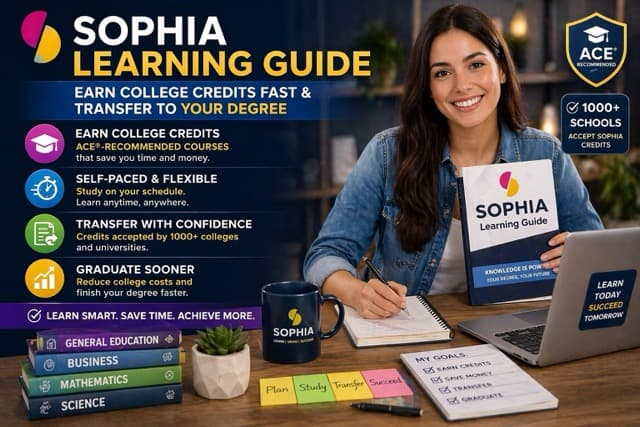
Here's a number worth sitting with: the average American college student pays around $38,000 per year at a four-year private university. Four years. You do the math. Now here's another number - Sophia Learning credits cost roughly $79-99 per month, and you can knock out multiple college-level courses in that time.
That's not a typo. Students are genuinely earning Sophia Learning credits for a fraction of what they'd pay in a traditional classroom, then transferring those credits toward real degrees at real universities. WGU, SNHU, ASU, GCU - the list of schools accepting Sophia credits keeps growing. But (and this is important) it's not magic, and it's not for everyone.
This guide breaks down everything you actually need to know about Sophia Learning credits - how they work, which colleges accept them, how to transfer them, and whether the whole thing is worth your time. No fluff, no hype. Just the real picture so you can decide if this path makes sense for your situation.
What Is Sophia Learning and How Does It Work?
Sophia Learning is an online education platform offering self-paced college-level courses that are reviewed and recommended by the American Council on Education (ACE). The ACE credit recommendation is the key thing here - it's what allows Sophia Learning college credits to potentially transfer to partner institutions and ACE-accepting schools.
The model is simple. You pay a monthly subscription (think Netflix, but for college credits), work through course materials at whatever pace works for you, pass the assessments, and then request a transcript. No classes to attend. No semesters to wait for. No professor office hours to schedule around your work schedule.
Sophia offers courses across several key subject areas:
- Communications: Public Speaking, Business Communications, Interpersonal Communications
- Math: College Algebra, Statistics, Quantitative Reasoning
- English & Humanities: English Composition, Literature, Critical Thinking
- Social Sciences: Introduction to Psychology, Sociology, Political Science
- Science: Introduction to Biology, Earth Science, Environmental Science
- Business: Principles of Management, Business Ethics, Accounting
- Technology: Introduction to IT, Networking Fundamentals
See the pattern? These are mostly general education requirements - the kinds of foundational courses every degree program demands, regardless of your major. That's intentional. Sophia's sweet spot is helping students satisfy gen-ed requirements at a fraction of the cost of traditional courses.
One thing worth understanding about Sophia Learning 1 credit courses vs 3 credit courses: most Sophia offerings are worth 3 semester hours, which is the standard single-course credit load. Some shorter courses carry fewer credits. Always check the specific credit value before enrolling, especially if you're targeting a specific credit count for transfer purposes.
Are Sophia Learning Credits Transferable?
This is the question everyone asks, and the honest answer is: it depends on the school. Yes, Sophia Learning credits are transferable - but not universally, and not automatically.
Here's how it actually works. Sophia Learning is accredited through ACE (American Council on Education), which is a recognized body that evaluates non-traditional education. When a college says they "accept ACE-recommended credit," they're generally open to reviewing Sophia credits. But "open to reviewing" and "will definitely accept" aren't the same thing.
Each school makes its own determination about:
- Whether the specific Sophia course matches a course in their catalog
- How many transfer credits they'll accept from alternative sources
- Whether the credits count toward your major requirements or only as electives
- What grade you need to earn for the credit to transfer (most require a C or better)
The good news is that the list of schools accepting Sophia credits has grown substantially. Many large online universities - particularly those serving adult learners - have built explicit partnerships with Sophia or have clear policies about ACE credit acceptance. That's where Sophia Learning really shines.
If you're worried about whether your credits will count, our online class support services can help you navigate the transfer process and ensure you're taking the right courses for your specific degree program.
What Colleges Accept Sophia Learning Credits?
Let's get specific. These are the schools most frequently cited as accepting Sophia Learning credits - though you should always verify directly with the institution for your specific program and current policies.
Strong Acceptance History
- Western Governors University (WGU): One of the most Sophia-friendly universities. WGU accepts Sophia credits for many programs and is particularly popular among working adults. If you're asking "does WGU accept Sophia Learning credits" - generally yes, especially for gen-ed requirements.
- Southern New Hampshire University (SNHU): SNHU has a well-established transfer credit process and accepts many Sophia courses. How many credits does SNHU accept from Sophia Learning? That depends on your program, but SNHU is known for being transfer-friendly overall.
- Grand Canyon University (GCU): GCU accepts Sophia credits for many programs, particularly general education requirements. Students frequently use Sophia to satisfy GCU's gen-ed requirements before transferring.
- Purdue Global: Has an established ACE credit acceptance policy and has worked with Sophia Learning students.
- American Military University (AMU): AMU accepts ACE-recommended credits and has specific transfer credit policies that often accommodate Sophia courses.
Variable Acceptance (Check Directly)
- Arizona State University (ASU): Some programs accept Sophia credits, others don't. ASU's transfer credit policies vary significantly by college within the university.
- University of Maryland Global Campus (UMGC): UMGC has accepted Sophia credits for certain programs. Check their specific transfer equivalency tool.
- Excelsior University: Accepts many ACE-recommended courses. The process for transferring Sophia Learning credits to Excelsior is reasonably well-documented.
- Liberty University: Has accepted some Sophia credits but policies vary by program.
- Community Colleges: Many community colleges that accept Sophia Learning credits exist across the country, but this varies enormously by state and institution.
Schools with Limited or No Sophia Acceptance
Traditional four-year universities - your state flagship schools, Ivy League, most private liberal arts colleges - are generally not on board. If you're targeting FSU, FIU, UCF, or similar state schools, the answer is often no or highly limited. Same goes for most nursing-specific programs at places like Chamberlain University or ECPI - even though students frequently ask about it, nursing accreditation requirements make these schools much stricter about transfer credits.
Sophia vs Straighterline: Which Is Better?
If you've been researching cheapest college credits online, you've probably run into both Sophia Learning and Straighterline. They serve similar audiences with similar models, so the comparison is worth addressing directly.
Both platforms offer self-paced, subscription-based online courses with ACE credit recommendations. Both are legitimate options for earning affordable college credit. The differences come down to specifics.
| Feature | Sophia Learning | Straighterline |
|---|---|---|
| Pricing Model | ~$79-99/month subscription | ~$99/month + per-course fees |
| Course Variety | 50+ courses | 60+ courses |
| Credit Type | ACE recommended | ACE recommended + some partner school credit |
| University Partnerships | Strong (WGU, SNHU, GCU) | Strong (ASU, SNHU, many others) |
| Course Speed | Very fast possible (1-2 weeks) | Fast (2-4 weeks typical) |
| Instructor Support | Limited, mostly self-directed | Some instructor interaction available |
Here's my honest take: if you're targeting WGU specifically, Sophia Learning is probably your best bet - the partnership is strong and the course equivalencies are well-established. If you're targeting ASU or a school with stronger Straighterline ties, go with Straighterline. If you're not sure, check which platform has better equivalencies for your specific target school before committing.
And if you're taking online courses and want help managing the coursework alongside your regular life, our online class tutoring service can help you stay on track and complete courses efficiently.
Need Help Managing Your Online Coursework?
Whether you're navigating Sophia Learning, WGU, or any other online program, our tutoring team can help you complete courses faster and with less stress.
Fastest Sophia Learning Courses to Complete
Since you're paying by the month and working to earn college credits fast, speed matters. Some Sophia courses can be knocked out in under a week by a motivated student. Others are denser and take longer. Here's what students typically report as the most completable in minimal time.
Typically Fastest (1-2 Weeks)
- Introduction to Communication: Very accessible content, mostly conceptual. Students with any professional background tend to fly through this.
- Foundations of English Composition: If you're already a decent writer, this is straightforward.
- Introduction to Ethics: Concept-heavy but no heavy math or technical content.
- Critical Thinking: Logical and engaging. Many students find this one genuinely interesting.
- Principles of Management: Practical content that working adults often find intuitive.
Moderate Time (2-4 Weeks)
- Introduction to Statistics: Takes practice to get through the quantitative material, but very doable.
- Introduction to Psychology: Dense with content but genuinely interesting material.
- US History: Broad content coverage means more to learn, but manageable.
- College Algebra: Depends heavily on your math background. Quick for math-comfortable students, longer for others.
The Sophia Learning hours required for each course aren't standardized, but expect roughly 30-60 hours of total engagement per 3-credit course. That's spread across readings, video lessons, practice activities, and assessments. A motivated student doing 4-6 hours a day can finish in a week. Someone doing 1-2 hours on evenings after work is looking at 3-4 weeks.
How to Transfer Sophia Learning Credits
Okay, you've completed your courses. Now what? Here's the actual step-by-step process for how to transfer credits from Sophia Learning to your college.
Step 1: Request Your Official Transcript
Log into your Sophia Learning account and navigate to the transcript request section. You'll need to specify where to send it - most schools want an electronic transcript sent directly from Sophia, though some accept PDF transcripts you download yourself. There's usually a small fee for official transcript delivery.
Step 2: Submit to Your College's Registrar
Don't send it to admissions. The registrar's office handles transfer credits. Submit your Sophia transcript along with whatever transfer credit petition form your school requires. Many schools now have online portals for this.
Step 3: Provide Course Documentation
Some schools, especially ones without pre-established Sophia equivalencies, will want course descriptions and syllabi to evaluate what you learned. Sophia provides these documents in your account. Download them before submitting your transfer request.
Step 4: Wait for Evaluation
Transfer credit evaluation typically takes 2-6 weeks. Schools with established Sophia partnerships may have automated equivalencies that make this faster. Others do a manual review.
Step 5: Appeal If Necessary
If credits aren't accepted, you can sometimes appeal - especially if the course content clearly matches a required course. Ask the registrar what documentation would help your case. Some students have successfully transferred credits by connecting department chairs who could see the course equivalency directly.
For specific transfer paths - like how to transfer Sophia Learning credits to SNHU, WGU, GCU, UMGC, or Liberty University - each school has slightly different processes. WGU and SNHU in particular have dedicated transfer credit tools on their websites where you can check equivalencies before even completing the course.
If you're a WGU student specifically, our WGU exam support can help you navigate not just credit transfers but the entire WGU assessment process. It's a unique system and having guidance makes a big difference.
Sophia Learning Review: Is It Worth It?
Let's be real about what Sophia Learning is and isn't. Here's an honest Sophia Learning review based on what students actually experience.
What Works Well
- Cost: Genuinely among the cheapest college credits you can earn anywhere. If you can complete two or three courses per month, the per-credit cost is exceptional.
- Flexibility: Truly self-paced. No deadlines, no class times, no waiting for a semester to start. This is huge for working adults.
- Speed: Fast learners can earn credits much more quickly than in a traditional course. A 16-week semester course becomes a 2-week sprint.
- Platform Quality: The interface is clean and intuitive. Content quality is generally solid - not groundbreaking, but genuinely educational.
- Partner School Integration: For WGU, SNHU, GCU students especially, the transfer process is often smoother than with random ACE credit.
Where It Falls Short
- Limited Course Range: You won't find upper-division major courses here. Sophia is gen-ed territory, full stop.
- Not Universally Accepted: This is the big one. If your target school doesn't accept Sophia credits, you've spent time and money on uncreditable coursework.
- No Instructor Interaction: Self-directed learning works for some people and is miserable for others. If you need that human connection to stay motivated, Sophia can feel isolating.
- Assessment Limitations: Sophia's assessments are mostly knowledge-check style. You're not writing papers or doing complex projects, which may not prepare you as deeply for advanced coursework.
Bottom line: Sophia Learning is worth it if your target school has established Sophia credit acceptance for courses that fulfill requirements you actually need. It's not worth it if you're hoping the credits will work at a traditional four-year university that hasn't committed to accepting them.
How to Maximize Your Sophia Learning Credits
If you've decided Sophia Learning fits your situation, here's how to get the most out of it. This isn't just about completing courses - it's about completing the right courses in the right order for maximum credit impact.
1. Map Courses to Your Degree Plan First
Before you take a single Sophia course, get your degree plan from your target school and identify every gen-ed requirement. Then check which Sophia courses have established equivalencies for each requirement. Only take Sophia courses that have confirmed equivalencies. This sounds obvious, but you'd be surprised how many students take courses that end up counting as free electives when they needed them to fulfill specific requirements.
2. Use the Sophia Partner School Tools
Sophia's website has partnership information and some transfer equivalency data. WGU's website has a dedicated course equivalency search. SNHU has a transfer credit evaluator. Use these tools before enrolling - they exist specifically to help you avoid wasted effort.
3. Subscribe Strategically
Don't subscribe until you're ready to study. Since you're paying monthly, every week you're not actively studying is money down the drain. Line up your study schedule, clear your calendar as much as possible, then subscribe and go.
4. Stack Sophia With Other Credit-by-Exam Options
Sophia works best as part of a broader credit-acceleration strategy. Combine it with CLEP exams (which are accepted at far more schools) and DSST exams to cover gen-ed requirements from multiple angles. Use Sophia where it has established equivalencies, CLEP where Sophia doesn't.
5. Don't Neglect the Credly Badges
Sophia Learning's Credly badges are actually useful for professional development beyond academic credit. If you're in a field where demonstrating continuous learning matters - IT, business, healthcare - add these to your LinkedIn profile. They're a free credential you're already earning.
6. Consider Your Entire Credit Need Holistically
If you're looking to accelerate toward a degree broadly - not just save money on gen-eds but potentially get support across your entire program - look at full online class support options. Our Sophia class assistance service can help you navigate courses more efficiently and make sure you're earning the credits you need.
And if you're navigating the broader challenge of balancing online coursework with work and life commitments, our fast online class pass tutoring program has helped hundreds of students complete their courses efficiently and get on with their degrees.
Frequently Asked Questions
Are Sophia Learning credits accredited?
Sophia Learning courses are ACE-credit recommended, meaning they have been reviewed by the American Council on Education (ACE). This is a widely recognized accreditation standard, but it doesn't guarantee that every college will accept them. You need to verify with your specific institution whether they accept ACE-recommended credit.
Do Sophia Learning credits expire?
Sophia Learning credits themselves don't technically expire - your transcript stays valid. However, some colleges have policies about accepting credits from courses completed more than 5-10 years ago. It's best to use your Sophia credits within a few years of earning them, especially for technology or rapidly evolving subjects.
How many credits can you get from Sophia Learning?
There's no hard cap on how many Sophia Learning courses you can take, but most colleges limit how many credits they'll accept from any single alternative credit source - often 30 credits or fewer. Check your target school's transfer credit policy before banking on a large number of Sophia credits.
Does WGU accept Sophia Learning credits?
Yes, WGU (Western Governors University) accepts Sophia Learning credits for many programs. This makes Sophia particularly popular among WGU students since WGU's competency-based model aligns well with self-paced learning. Specific course equivalencies vary by program, so check WGU's transfer credit database for your particular degree.
Does SNHU accept Sophia Learning credits?
Southern New Hampshire University (SNHU) accepts Sophia Learning credits for many programs. SNHU has a clear transfer credit evaluation process and will review your Sophia transcripts to determine what applies toward your degree. Contact SNHU's admissions team with your specific Sophia course list for a preliminary evaluation.
Does ASU accept Sophia Learning credits?
Arizona State University (ASU) has accepted Sophia Learning credits for some programs, particularly through ASU Online. However, ASU's acceptance can vary significantly by program and college within the university. Always verify directly with ASU's transfer credit office and have them evaluate your specific courses.
How do I transfer Sophia Learning credits to my college?
To transfer Sophia Learning credits, first complete your courses and earn a passing grade. Then request an official transcript through Sophia's website (usually sent electronically). Submit this transcript to your college's registrar along with a transfer credit petition. Many schools require a course equivalency evaluation, so be prepared to provide course descriptions and syllabi.
What is the Sophia Learning cost and is it worth it?
Sophia Learning operates on a subscription model - typically around $79-99 per month - and you can complete multiple courses per month. Since you only pay per month of access, completing courses quickly makes it extremely cost-effective. Compare that to $500-3,000+ per credit hour at traditional schools and you can see why it attracts budget-conscious students.
How long does it take to complete a Sophia Learning course?
Most Sophia Learning courses can be completed in 2-6 weeks with consistent effort, and motivated students often finish in under two weeks. The courses are self-paced with no deadlines, so you control the timeline. Since you're paying monthly, finishing faster saves money and makes the per-credit cost lower.
Does Grand Canyon University (GCU) accept Sophia Learning credits?
Grand Canyon University has accepted Sophia Learning credits for certain courses, particularly general education requirements. However, GCU's acceptance policies can change and vary by program. Contact GCU's admissions or transfer credit team with your specific Sophia course list for a current evaluation.
Can I use Sophia Learning credits to satisfy general education requirements?
Yes, and that's actually the sweet spot for Sophia Learning. Most Sophia courses are designed to cover general education requirements like college math, English composition, communications, and social sciences - the kinds of courses every degree program requires. This is where Sophia credits offer the most bang for your buck.
What is a Sophia Learning Credly badge?
Sophia Learning partners with Credly to provide digital badges for completed courses. These are shareable credentials you can display on LinkedIn or include in job applications. While they're supplementary to the academic transcripts for college transfer, they add practical value for professional development and demonstrating skills to employers.