
Let's be real - nursing exams are brutal. They're not like other tests where you can memorize facts and regurgitate them. Nursing exam preparation requires a completely different approach because these exams test how you think, not just what you know.
Every nursing student knows that sinking feeling. You studied for hours, you knew the material, but the exam questions seemed like they were written in another language. "All of these answers could be right..." Sound familiar?
Here's the thing though - there's a method to passing nursing exams. Whether you're preparing for your first med-surg final, the dreaded NCLEX, or one of those ATI proctored exams, the strategies that work are pretty consistent. And they're probably not what you're doing right now.
This guide covers everything from effective study strategies to test-taking techniques that actually work. We'll dig into how to study for nursing exams in ways that stick, tackle test anxiety, and give you a realistic study schedule template. Whether you're struggling to pass or aiming to ace your exams, these nursing exam tips will change your approach.
Why Nursing Exams Are Different
Before we get into nursing exam preparation strategies, let's talk about why these exams trip up so many smart students. Understanding this will change how you approach your studying.
Traditional exams test recall - did you memorize the facts? Nursing exams test application - can you use those facts to make clinical decisions? That's a fundamentally different skill, and it requires different preparation.
The NCLEX-Style Question Format
Most nursing programs now use NCLEX-style questions for their exams. These questions are designed to assess clinical judgment, not memorization. You'll encounter:
- Priority questions: "Which patient should the nurse see first?"
- Implementation questions: "What is the nurse's best action?"
- Assessment questions: "What should the nurse assess first?"
- Select-all-that-apply (SATA): Multiple correct answers to identify
- Delegation questions: "Which task can be delegated to the UAP?"
If you're studying by reading the textbook and highlighting, you're preparing for the wrong type of test. Nursing exam preparation needs to match the test format - which means lots of practice questions and critical thinking exercises.
Types of Nursing Exams You'll Face
Throughout your nursing journey, you'll encounter different types of exams. Each has its quirks, but the fundamental preparation strategies overlap significantly.
Nursing School Course Exams
Your regular semester exams - med-surg, pharmacology, pediatrics, OB, mental health, and so on. These typically cover specific content areas and align with your textbook chapters. Most schools require a 77% or higher to pass (though this varies).
Standardized Testing (ATI, HESI)
Many nursing programs use ATI or HESI exams throughout the curriculum. These standardized tests help predict NCLEX success and often count toward your course grade. They're broader than course exams and require cumulative knowledge.
Nursing Entrance Exams
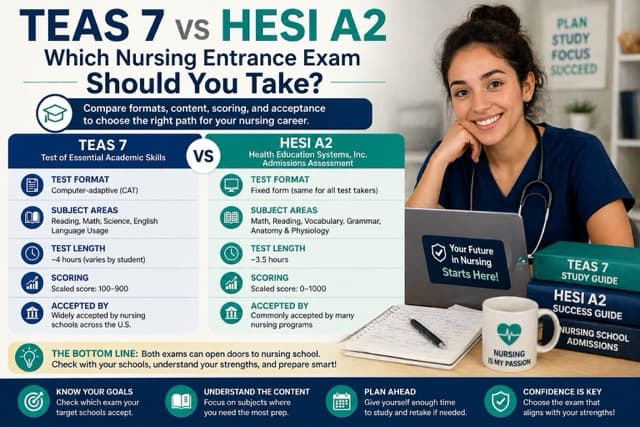
Before you even start nursing school, you'll likely face the TEAS exam or HESI A2. These entrance exams test general academic readiness - reading, math, science basics, and English skills.
The NCLEX
The big one. The National Council Licensure Examination determines whether you can practice as a nurse. It's a computer-adaptive test (CAT) that adjusts difficulty based on your performance. You need between 75 and 145 questions to pass (or fail), depending on how clearly you demonstrate competence.
Effective Study Strategies for Nursing
Here's where most nursing students go wrong. They study the way they always have - reading, highlighting, maybe making some flashcards. But that approach doesn't work for nursing exams. Let me show you what does.
Active Recall Over Passive Review
Stop rereading your notes. Seriously. Research consistently shows that active recall - testing yourself on material - leads to much better retention than passive review. For nursing exam preparation, this means:
- Practice questions first: Before reading a chapter, try some questions on the topic. You'll bomb them, but you'll know what to focus on.
- Teach back: Explain concepts out loud as if teaching a patient. If you can't explain it simply, you don't understand it.
- Create questions from notes: Turn your notes into questions, then answer them the next day.
- Use practice tests frequently: Not just before exams - regularly throughout your studying.
Spaced Repetition
Your brain forgets things in a predictable pattern. Spaced repetition fights this by reviewing material at increasing intervals. For nursing content:
- Review new material the same day you learn it
- Review again after 1 day
- Review again after 3 days
- Review again after 1 week
- Review again after 2 weeks
Apps like Anki automate this process, but you can do it manually with a calendar and flashcards too.
Concept Mapping
Nursing knowledge is interconnected. Heart failure affects respiratory function. Kidney disease impacts medication dosing. Diabetes touches every body system. Concept maps help you see these connections visually.
When you're studying a condition, map out: pathophysiology → signs/symptoms → diagnostics → nursing interventions → patient education → complications. This holistic view matches how exam questions are structured.
Study Groups - When They Work
Study groups can be amazing or a complete waste of time. They work when:
- Everyone comes prepared with specific questions or topics
- You discuss clinical scenarios and work through problems
- Members quiz each other with practice questions
- You explain concepts to each other (teaching reinforces learning)
They don't work when they become social hour or when one person does all the explaining. Be honest with yourself - is your study group helping you learn or making you feel productive while accomplishing little?
Test-Taking Strategies That Actually Work
Knowing the content is only half the battle. Test-taking strategies can make the difference between passing and failing, especially when you're stuck between two answers that both seem right.
Read Every Word of the Question
Nursing questions often contain crucial qualifiers that change the answer. Watch for:
- FIRST vs BEST: "First" implies sequence; "best" implies priority
- MOST vs ALL: "Most important" narrows options; SATA questions want multiple answers
- IMMEDIATE vs PRIORITY: "Immediate" suggests urgency; "priority" suggests most important
- Time frames: "2 days post-op" changes expectations vs "2 hours post-op"
- Stable vs unstable: Changes appropriate interventions and delegation options
The ABCs and Maslow's Hierarchy
When prioritizing, remember:
Priority Framework:
- 1. Airway: Always first. If the patient can't breathe, nothing else matters.
- 2. Breathing: Oxygenation issues come next.
- 3. Circulation: Cardiac and perfusion concerns.
- 4. Disability/Neuro: Neurological status.
- 5. Everything else: Pain, comfort, education, etc.
Maslow's hierarchy also applies: physiological needs (oxygen, food, water, elimination) before safety, before psychological needs, before self-esteem, before self-actualization.
Eliminate Wrong Answers
Before selecting your answer, systematically eliminate wrong options:
- Absolutes are usually wrong: Words like "always," "never," "all," "none" are red flags
- Extremes are suspect: The most drastic intervention is rarely correct
- Delegation violations: Tasks outside scope of practice are wrong
- Assessment before intervention: If you haven't assessed, you usually can't intervene
The Two-Answer Trap
Stuck between two answers? Ask yourself:
- Which answer is more assessment-focused vs intervention?
- Which answer addresses the immediate vs long-term problem?
- Which answer is nursing-specific vs medical?
- Which answer is more patient-centered?
For nursing exam preparation, practice this technique with every practice question. It'll become automatic.
NCLEX Preparation Tips
The NCLEX is the culmination of your nursing education. After years of school, clinicals, and exams, it all comes down to this test. But here's the good news - if you've been preparing properly throughout nursing school, you're already most of the way there.
When to Start Preparing
Most successful candidates begin dedicated NCLEX prep 6-8 weeks before their test date. If you scored well on your ATI or HESI predictor exams, you might need less time. If you struggled, give yourself 10-12 weeks.
Question Banks Are Essential
You need a high-quality question bank. Period. The most popular options:
- UWorld: Gold standard. Excellent rationales. Most similar to actual NCLEX.
- Archer Review: More affordable, solid questions, good readiness assessment.
- Kaplan: Established review program with content and questions.
- NCLEX High Yield: Popular for last-minute review and key concepts.
Aim to complete 3,000-4,000 questions during your preparation period. That's about 75-150 questions per day if you're studying full-time for 6 weeks.
Content Review Balance
Balance your time between content review and questions. A common approach:
- Weeks 1-2: 60% content review, 40% questions
- Weeks 3-4: 40% content review, 60% questions
- Weeks 5-6: 20% content review, 80% questions
If you're struggling with specific content areas, our nursing exam tutoring services can help you work through difficult concepts and develop personalized study strategies.
Managing Test Anxiety
Test anxiety is real, and it affects nursing students more than most. The stakes are high, the questions are hard, and the pressure can be overwhelming. But anxiety is manageable - and managing it is part of nursing exam preparation.
Preparation Reduces Anxiety
The best anxiety reducer is confidence, and confidence comes from preparation. When you've done thousands of practice questions and seen similar scenarios before, tests feel less threatening. No shortcuts here - put in the work.
Physical Strategies
- Sleep: 7-8 hours before exam day. Sleep deprivation mimics anxiety symptoms.
- Exercise: Regular physical activity reduces baseline anxiety levels.
- Nutrition: Eat protein and complex carbs before exams. Avoid heavy meals and excessive caffeine.
- Breathing: 4-7-8 technique - inhale for 4 seconds, hold for 7, exhale for 8.
Cognitive Strategies
- Reframe thoughts: "I'm going to fail" becomes "I'm prepared, and I'll do my best"
- Focus on the present question: Don't think about previous questions or results
- Positive visualization: Imagine yourself calmly answering questions and succeeding
- Accept imperfection: You don't need 100%. You need to pass.
Creating Your Study Schedule
A structured schedule keeps you on track and prevents last-minute panic. Here's a template you can adapt for nursing school exams or NCLEX preparation.
For Nursing School Exams (2-Week Plan)
- Week 2 before exam: Review all lecture notes and reading materials. Create summary sheets or concept maps. Complete 50-75 practice questions on the topic.
- Week 1 before exam: Focus on practice questions (100-150 total). Review weak areas identified. Complete at least one full practice test. Light review only in final 2 days.
For NCLEX (6-Week Plan)
- Weeks 1-2: Content review by system. 50-75 questions per day. Focus on fundamentals and high-yield topics.
- Weeks 3-4: Shift to more questions (100-125 per day). Targeted content review based on weak areas. Take 1 full-length practice exam per week.
- Weeks 5-6: Heavy question focus (125-150 per day). Review rationales thoroughly. Light content review. Take 2-3 practice exams total. Final 2 days: light review, rest, prepare mentally.
Daily Study Structure
For a typical 4-hour study day:
- Hour 1: Content review or reading (active, not passive)
- Hours 2-3: Practice questions with thorough rationale review
- Hour 4: Review weak areas identified in practice questions
- Throughout: Take 10-minute breaks every 45-50 minutes
Common Mistakes to Avoid
After helping countless nursing students, these are the mistakes we see most often. Avoid them and you're already ahead of most of your classmates.
Mistake #1: Passive Studying
Reading and highlighting feels productive but doesn't work for nursing exams. If you're not actively testing yourself, you're probably wasting time.
Mistake #2: Ignoring Rationales
Doing hundreds of practice questions means nothing if you skip the rationales. The learning happens in understanding why answers are correct or incorrect, not in getting a high score.
Mistake #3: Cramming
Nursing content is too vast and complex for last-minute cramming. Distributed study over weeks beats intensive study over days. Your brain needs time to consolidate information.
Mistake #4: Studying in the Wrong Format
If your exams use NCLEX-style questions, practice NCLEX-style questions. If they use ATI format, practice ATI format. Match your preparation to what you'll face.
Mistake #5: Not Taking Care of Yourself
Sleep deprivation, poor nutrition, and chronic stress hurt your performance and your studying. You can't pour from an empty cup - take care of your basic needs.
Nursing exam preparation doesn't have to feel impossible. With the right strategies, consistent effort, and smart study habits, you can pass your nursing exams and move forward in your career. The strategies in this guide work - but only if you actually use them.
Start today. Pick one strategy from this guide and implement it. Then add another. Build the habits that will carry you through nursing school, through the NCLEX, and into a successful nursing career.
And if you need additional help along the way, explore our nursing exam assistance services or check out our guides for specific exams like the TEAS exam and HESI A2.
Frequently Asked Questions
How should I study for nursing exams?
For nursing exam preparation, focus on understanding concepts rather than memorizing facts. Use active recall by testing yourself frequently, and practice applying knowledge to patient scenarios. Study in short, focused sessions (45-90 minutes) with breaks. Create study groups for discussing complex topics, use NCLEX-style practice questions even for school exams, and prioritize understanding pathophysiology and nursing interventions. Visual learners benefit from concept maps, while audio learners can record and listen to key points.
How can I pass nursing school exams?
To pass nursing school exams: (1) Attend every lecture and take active notes - professors often emphasize test material. (2) Read assigned chapters before class, not just after. (3) Use NCLEX-style question banks even for regular exams - nursing schools increasingly use similar question formats. (4) Form study groups but also study alone to identify your weak areas. (5) Focus on nursing interventions and prioritization, not just disease processes. (6) Practice critical thinking by asking 'why' for every nursing action. (7) Don't cram - distributed study over time works better for nursing content.
What is the best way to prepare for NCLEX?
The best NCLEX preparation includes: completing 3,000-4,000 practice questions from reputable sources like UWorld, Kaplan, or Archer Review. Focus on understanding rationales, not just getting answers right. Study content by system but prioritize high-yield topics like safety, infection control, and medication administration. Take full-length practice exams to build stamina. Start preparing 2-3 months before your test date. Review the NCLEX test plan from NCSBN to understand content distribution. Many successful candidates also use content review books like Saunders Comprehensive Review.
How many questions should I practice for nursing exams?
For nursing school exams, aim for 50-100 practice questions per exam topic. For NCLEX preparation, most successful candidates complete 3,000-4,000 questions total over their preparation period - roughly 75-150 questions per day in the final weeks. Quality matters more than quantity though. Review every answer explanation, even for questions you get right. If you're consistently scoring 65%+ on practice questions, you're in a good position. Below 50% indicates you need more content review before doing additional questions.
Is the nursing entrance exam hard?
Nursing entrance exams like the TEAS, HESI A2, or Kaplan vary in difficulty based on your preparation. The TEAS covers reading, math, science, and English - it's challenging if you haven't reviewed science concepts since high school. HESI A2 is similar but often includes additional sections like anatomy and physiology. With 4-6 weeks of focused preparation using official study guides and practice tests, most students can achieve competitive scores. The biggest challenge is usually the science sections, which require memorization of anatomy, physiology, and basic chemistry.
How do I manage test anxiety during nursing exams?
For nursing test anxiety: (1) Practice under timed conditions regularly so testing feels familiar. (2) Use breathing techniques - 4-7-8 breathing (inhale 4 seconds, hold 7, exhale 8) before and during tests. (3) Arrive early but don't study right before - review notes an hour before, then relax. (4) During the test, skip hard questions and return later - momentum builds confidence. (5) Replace negative thoughts with rational ones ('I've prepared well' vs 'I'm going to fail'). (6) Physical preparation matters - sleep 7-8 hours, eat protein and complex carbs, avoid excessive caffeine. (7) Consider speaking with a counselor if anxiety is severe.
What topics are most important for nursing exams?
Key nursing exam topics include: (1) Safety and infection control - always priority. (2) Medication administration and calculations - dose calculations appear frequently. (3) Priority and delegation - which patient to see first, what can be delegated. (4) Assessment findings - normal vs abnormal, when to notify provider. (5) Common conditions by system - cardiac, respiratory, renal, diabetes are heavily tested. (6) Lab values - know critical values and nursing interventions. (7) Maternal-child health - especially for NCLEX. (8) Mental health and therapeutic communication. Focus your study time on these high-yield areas.
How long should I study for nursing finals?
Start preparing for nursing finals 2-3 weeks in advance. Break the content into daily study sessions of 2-4 hours. During the first week, review all lecture materials and create summary notes or concept maps. Week two, focus on practice questions and identifying weak areas. The final week, do targeted review of weak areas and take practice tests. Avoid cramming the night before - your brain needs sleep to consolidate learning. For comprehensive finals covering the entire semester, extend to 4 weeks of preparation.
Should I use flashcards for nursing exams?
Flashcards work well for certain nursing content - particularly lab values, medication side effects, and quick facts. However, nursing exams test critical thinking more than recall, so flashcards shouldn't be your primary study method. Use them for: medication names/classifications, normal lab values, assessment findings for specific conditions, and key nursing interventions. Apps like Anki use spaced repetition for efficient memorization. Combine flashcards with practice questions that require applying the information in clinical scenarios.
What's the pass rate for NCLEX?
NCLEX-RN pass rates for first-time, US-educated test takers typically range from 85-90%. However, this varies significantly by nursing program - some schools have 95%+ pass rates while others fall below 80%. International graduates have lower pass rates, often around 50-60%. For NCLEX-PN, first-time pass rates are similar, around 85%. Your individual chances depend heavily on your nursing school's program quality, your grades (especially in clinical courses), and the quality of your NCLEX preparation. Students who complete comprehensive review courses generally have higher pass rates.
How do I improve my nursing test scores?
To improve nursing test scores: (1) Analyze your previous exams - look for patterns in questions you miss. (2) Switch to active study methods - practice questions, teaching others, creating concept maps instead of passive reading. (3) Focus on understanding rationales - know why interventions are correct, not just what to do. (4) Improve your test-taking skills - learn to identify key words in questions, eliminate wrong answers systematically. (5) Address content gaps immediately after each exam. (6) Use the testing format you'll face - if your school uses ATI or HESI, practice those formats. (7) Get enough sleep before exams - sleep deprivation significantly impairs performance.
Do nursing entrance exams affect admissions?
Yes, nursing entrance exams significantly affect admissions. Most programs use TEAS, HESI A2, or Kaplan scores as part of a weighted admission formula. Some programs have minimum score requirements - failing to meet the cutoff means automatic rejection regardless of GPA. Competitive programs may require scores in the 80th percentile or above. Many schools allow retakes (usually with waiting periods), but some limit attempts or average scores. Check your target school's specific requirements early and aim to exceed minimums since many qualified applicants compete for limited spots.