A career change to nursing is one of the most significant professional moves you can make - and in 2026, it might also be one of the smartest. The nursing shortage isn't a future problem. It's here, it's real, and hospitals across the country are desperately competing for qualified nurses with signing bonuses, relocation packages, and salaries that would have seemed impossible a decade ago.
But here's what nobody tells you when you start Googling "career change to nursing": the path forward can feel overwhelming. Nursing school requirements, entrance exams, accelerated programs, ADN vs. BSN, TEAS vs. HESI - it's a lot to sort through. Especially if you've been working in a completely different field for years.
This guide cuts through all of that. Whether you're 28 or 48, whether you're making a career change to nursing from education, engineering, business, or something else entirely - we're going to walk through exactly what you need to do, in what order, to get certified and start working as a nurse in 2026.
Why a Career Change to Nursing Makes Sense in 2026
Let's start with the obvious question: why nursing, and why now? Because the data here is pretty hard to argue with.
The U.S. Bureau of Labor Statistics projects that employment for registered nurses will grow 6% through 2032 - faster than average for all occupations. That translates to roughly 193,000 new RN jobs every single year. And that doesn't even account for the massive wave of Baby Boomer nurses retiring from the workforce. We're talking about a genuine, structural shortage of nurses that isn't going away anytime soon.
What does that mean practically for someone making a career change to nursing? It means:
- Job security that's nearly unmatched. Nurses don't get laid off in economic downturns. People get sick regardless of market conditions.
- Geographic flexibility. Nursing shortage jobs exist everywhere - rural hospitals, urban medical centers, home health agencies, schools, corporations. If you want to move, your skills move with you.
- Competitive salaries that keep rising. Starting RN salaries now commonly range from $60,000-$80,000 depending on location, with travel nursing opportunities pushing total compensation well above $100,000 for experienced nurses.
- Real meaning in the work. Look, not everyone finds deep satisfaction in their current career. Nursing is hard, yes - but it's hard in a way that most nurses find deeply worthwhile.
And the nursing shortage isn't just about hospital jobs. Telehealth nursing, school nursing, corporate health management, public health - the career paths available to an RN in 2026 are more diverse than ever before.
Is Nursing the Right Career Change for You?
Okay, before we get into the how-to, let's be honest about something. Nursing isn't for everyone - and that's not a dig at anyone. It's just a reality check that will save you time, money, and potential heartbreak if the fit isn't there.
Nursing involves direct patient care. You'll be dealing with people in pain, fear, and vulnerability on a daily basis. The physical demands are real - 12-hour shifts, often on your feet, lifting and repositioning patients. And emotionally? You need to be able to handle both the rewarding moments and the genuinely difficult ones, including patient deaths.
You're probably a great fit for nursing if:
- You've been drawn to healthcare before but weren't sure how to get there
- You're a natural problem-solver who stays calm under pressure
- You genuinely like people and find helping others energizing, not draining
- You don't mind science - or you're willing to learn it
- You want shift work flexibility (this is actually a plus for many career changers with families)
Your existing career experience is more valuable than you think, by the way. Making a career change to nursing from education? You already understand how to communicate complex information clearly - a skill patients desperately need. Career change from engineering to nursing? You're wired for systematic problem-solving, which is huge in clinical settings. Business background? Healthcare administration and case management will want you eventually.
The point is: your past experience isn't irrelevant. It's actually an asset, even if it doesn't look like it on a nursing school application.
Nursing School Requirements: What You Actually Need
Here's where things get practical. Nursing school requirements vary by program, but most programs want to see the same core things. Let's walk through what you actually need to apply.
Prerequisite Science Courses
This is the biggest hurdle for most career changers, and it's important to address it honestly. Most nursing programs require the following prerequisite courses - and most require them to have been completed within the last 5-7 years:
- Anatomy and Physiology I and II (often with lab)
- Microbiology (with lab for many programs)
- Chemistry (General or Organic, depending on program)
- Biology
- Statistics or College Math
- Psychology (Introduction and often Developmental/Lifespan)
- English Composition
- Nutrition (required by some programs)
If you've been out of school for a while, you may need to retake some of these even if you took them before. That's not a setback - it's just part of the process. Community colleges are an affordable way to knock out prerequisites before applying to a competitive nursing program.
GPA Requirements
Most programs have a minimum GPA requirement around 3.0, but competitive programs (especially Accelerated BSN programs at well-known universities) often have average incoming GPAs of 3.4-3.7. Your science GPA matters a lot here - admissions committees pay close attention to how you performed in the prerequisites.
Other Application Requirements
- Entrance exam score (TEAS or HESI A2 - see next section)
- Personal statement / essay
- Letters of recommendation (2-3 typically)
- Current CPR certification (BLS level)
- Background check clearance
- Health immunization records
- Sometimes: healthcare work or volunteer experience (increasingly required or strongly preferred)
One more thing worth knowing: nursing program admissions are competitive, but they're holistic. Your personal statement matters. A compelling career change narrative - why you're leaving your previous field, what draws you to nursing, what you bring from your experience - can genuinely differentiate your application.
Entrance Exams: TEAS, HESI, and What to Expect
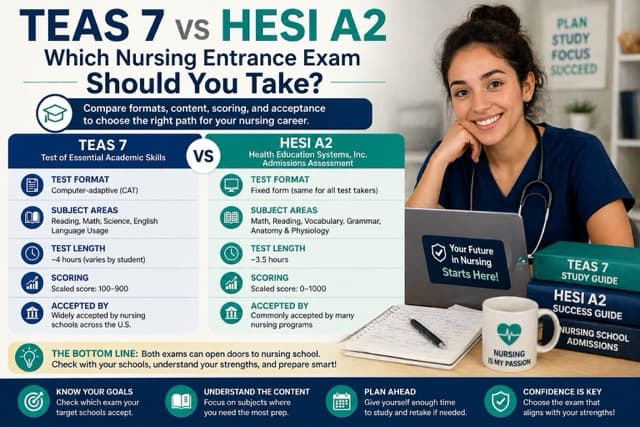
Almost every nursing program requires an entrance exam. The two most common are the ATI TEAS (Test of Essential Academic Skills) and the HESI A2 (Health Education Systems, Inc. Admission Assessment). You don't get to pick - the program you're applying to tells you which one they use.
ATI TEAS for Career Changers
The TEAS is probably the more widely used of the two. It covers four areas: Reading, Mathematics, Science, and English and Language Usage. Total testing time is about 3.5 hours. Scores are reported as a percentage, and most programs want to see at least 65-70% - though the more competitive programs want 75% or higher.
For career changers, the Science section is often the biggest challenge if you haven't had recent coursework. It covers human anatomy, physiology, biology, and chemistry. The Math section covers fractions, ratios, proportions, and basic algebra - nothing too advanced, but you need to be accurate and work quickly.
The good news? The TEAS is very learnable with focused preparation. Most career changers who dedicate 4-8 weeks to TEAS prep hit their target score. Our TEAS exam support services can help you approach this test strategically rather than studying everything blindly.
HESI A2 for Career Changers
The HESI A2 is similar in scope to the TEAS but has a slightly different structure. It includes sections on Reading Comprehension, Vocabulary and General Knowledge, Grammar, Basic Math Skills, Biology, Chemistry, Anatomy and Physiology, and sometimes Physics. Programs select which sections they require, so you won't always take all of them.
Scoring benchmarks vary by institution, but 75% or higher is generally considered competitive. If you're applying to programs that use the HESI, check out our HESI exam preparation resources and our detailed guide on HESI A2 study tips for a targeted prep approach.
Need Help Passing Your Nursing Entrance Exam?
Our expert tutors specialize in TEAS and HESI A2 preparation for career changers. Get a personalized study plan and start your nursing journey with confidence.
Fastest Paths to Becoming an RN as a Career Changer
Okay, so you know you want to make this career change to nursing. Now, what's the fastest realistic path forward? The answer genuinely depends on your educational background - specifically, whether you already have a bachelor's degree in any field.
Option 1: Accelerated BSN (ABSN) - Best for Career Changers with a Bachelor's Degree
If you already have a bachelor's degree - in literally anything - the Accelerated BSN is almost certainly your best path. These programs are specifically designed for second-career students and typically run 11-18 months of intensive coursework. You'll graduate with a BSN (Bachelor of Science in Nursing), which is the credential most hospitals prefer (and increasingly require).
The intensity is real - ABSN programs are not part-time endeavors. You're essentially completing a 4-year nursing degree in under 18 months. But for career changers who are motivated and willing to commit fully, it's hands-down the fastest route to becoming a registered nurse.
Option 2: Associate Degree in Nursing (ADN)
No bachelor's degree? Or just want a more affordable entry point? The ADN (Associate Degree in Nursing) is a 2-year program typically offered at community colleges. It still qualifies you to sit for the NCLEX-RN licensing exam and become a registered nurse.
The trade-off is that some hospital systems now require BSN for hiring (particularly academic medical centers and Magnet hospitals), and BSN is essentially required for management roles. Many ADN nurses bridge to a BSN through online RN-to-BSN programs while working - so it's a viable path, just with an additional step.
Option 3: Direct Entry MSN (For Non-Nursing Graduates)
Some universities offer Direct Entry MSN programs for non-nurses with bachelor's degrees. These programs are 3-4 years long but lead directly to a Master of Science in Nursing, positioning you for advanced practice roles (Nurse Practitioner, Clinical Nurse Specialist) faster than the traditional BSN route. If you're aiming for NP or CNS practice, this path is worth investigating.
Regardless of which path you choose, after completing your nursing program you'll need to pass the NCLEX-RN to become licensed. Our NCLEX preparation guide breaks down exactly how to approach that final hurdle, and our nursing exam support services are available throughout your journey.
Career Change to Nursing at 30, 40, or 50: Is It Too Late?
Let's talk about this directly, because it's one of the most common questions - and concerns - among people considering a second career in nursing.
Short answer: no. It's not too late.
A career change to nursing at 30 is genuinely common - it's often people in their late 20s and early 30s who realize their first career path isn't fulfilling, and nursing represents a meaningful alternative with excellent career longevity ahead. You'll graduate in your early-to-mid 30s and have 30+ years of nursing ahead of you.
A career change to nursing at 40 is increasingly common as well. Yes, the physical demands of bedside nursing are real at any age, but 40 is not old in nursing. You bring emotional maturity, life experience, and professional skills that genuinely make you a better nurse. Many nurses don't transition to less physically demanding roles (case management, education, administration) until their 50s or 60s anyway.
Career change to nursing at 50? This is less common but absolutely not impossible. Be realistic about the physical demands of floor nursing and consider whether you'd be targeting clinical bedside work or aiming for roles like infusion nursing, clinic nursing, occupational health, or healthcare education - all of which are legitimate RN paths with less physical intensity.
One practical note for career changers in any age bracket: nursing programs actively welcome second-career students. Admissions committees know that a 42-year-old former teacher making a career change to nursing brings something a 22-year-old recent college graduate simply doesn't have yet. Your personal statement about why you're changing careers is actually an opportunity, not a liability.
Scholarships and Funding for Career Changers
Nursing school isn't cheap - especially ABSN programs at private universities, which can run $40,000-$70,000 for the full program. But there's more financial support available for nursing students than most people realize, and career changers in particular have access to some targeted opportunities.
Federal Programs
- NURSE Corps Scholarship Program: Covers tuition, fees, and a monthly stipend in exchange for committing to work in a Health Professional Shortage Area after graduation. Highly competitive but excellent for those willing to serve underserved communities.
- HRSA Nursing Workforce Diversity Program: Targets nursing students from disadvantaged backgrounds. If you qualify, worth pursuing.
- Federal Unsubsidized/Subsidized Loans: Standard financial aid applies to nursing school - fill out FAFSA regardless of your age or career status.
Hospital and Employer Programs
This is the one most career changers overlook: many hospitals will literally pay for your nursing education in exchange for an employment commitment after graduation. These "earn-while-you-learn" or tuition reimbursement programs are especially common in areas with acute nursing shortage jobs. Contact HR departments at local hospitals and ask directly about nursing education funding programs.
State-Level Programs
Many states have their own scholarship, loan forgiveness, or grant programs specifically targeting the nursing shortage. These vary enormously by state. Your state's Board of Nursing website and your state health department are good places to start investigating what's available where you live.
Scholarships for Career Changers Specifically
Organizations like the American Association of Colleges of Nursing (AACN), the American Nurses Foundation, and various specialty nursing organizations offer scholarships that are open to second-career nursing students. These don't require you to be a traditional 18-22 year old student - they specifically value diverse backgrounds and career experiences.
Your Action Plan: Timeline and Next Steps
Okay. You've read through everything. You're ready to make this career change to nursing happen. Here's a practical roadmap, organized by where you're starting from.
If You Have a Bachelor's Degree (ABSN Path)
- Months 1-3: Research and Prerequisites - Research ABSN programs in your area (and online hybrid options). Get your transcripts evaluated for prerequisite courses. Enroll in any missing prerequisites at a community college - especially Anatomy & Physiology and Microbiology if you're lacking them.
- Months 3-6: Entrance Exam Prep - Begin TEAS or HESI A2 preparation based on your target programs. Use our TEAS fast-pass tutoring or HESI A2 tutoring for structured preparation. Schedule your exam date.
- Months 6-9: Applications - Submit ABSN applications. Write a compelling personal statement about your career change. Secure letters of recommendation. Apply for financial aid and scholarships simultaneously.
- Months 9-12: Pre-Program Preparation - Once accepted, get CPR certified, complete health requirements, and mentally prepare for the intensity of ABSN coursework. Consider picking up hospital volunteering or patient care tech work to build clinical familiarity.
- Months 12-30: ABSN Program - Complete your accelerated program. Begin NCLEX prep in your final semester. Graduate. Pass your NCLEX-RN. Start working as an RN.
If You Don't Have a Bachelor's Degree (ADN Path)
The timeline is similar but typically runs 2-3 years total for the ADN program itself. Start at your local community college, complete prerequisites while working, then apply to the nursing program. After passing NCLEX-RN, many hospitals offer RN-to-BSN tuition assistance so you can complete your bachelor's while employed.
One final thought: this career change to nursing is a significant commitment, and the path forward requires both preparation and persistence. But here's what's true - people make this switch every single day, at every age, from every background imaginable. The nursing shortage means the field genuinely wants and needs career changers. And once you're in? The combination of job security, competitive pay, meaningful work, and career flexibility is really hard to match anywhere else.
If you want more guidance on what to expect from nursing exams along the way, check out our nursing exam preparation tips and our detailed CCRN exam preparation guide for when you're further along in your career. Our nursing exam fast-pass tutoring program is available to support you at every step.
Frequently Asked Questions
How long does a career change to nursing take?
It depends on the path you choose. An Accelerated BSN (ABSN) program for career changers typically takes 11-18 months if you already have a bachelor's degree in another field. An Associate Degree in Nursing (ADN) takes about 2 years. After completing your program, you must pass the NCLEX-RN exam before practicing as a registered nurse.
What are the nursing school requirements for career changers?
Most nursing programs require prerequisite science courses (Biology, Chemistry, Anatomy & Physiology, Microbiology), a minimum GPA (usually 3.0+), a passing score on an entrance exam (TEAS or HESI A2), CPR certification, and health/background clearances. If you have a non-nursing bachelor's degree, ABSN programs are specifically designed for you.
Is it hard to get into nursing school as a career changer?
Nursing school admissions are competitive - that's honest. But career changers often have advantages: work experience, demonstrated responsibility, and maturity. Your biggest hurdle will be completing prerequisite courses if you don't have a science background, and scoring well on the TEAS or HESI entrance exam.
What is the TEAS exam and how hard is it?
The ATI TEAS (Test of Essential Academic Skills) is a nursing entrance exam covering Reading, Math, Science, and English. It's scored 0-100%, and most programs want at least 65-70%, though competitive programs prefer 75%+. With 4-8 weeks of focused preparation, most career changers can hit their target score.
Can I make a career change to nursing at 40 or 50?
Absolutely - and it's more common than you might think. Many nursing programs actively welcome second-career students. Your life experience is genuinely valuable in patient care. Physically, nursing can be demanding, so it helps to be in good health, but plenty of nurses work well into their 60s. Age is not the barrier people think it is.
How much do nurses make as a starting salary?
New registered nurses typically earn $60,000-$75,000 annually, depending on location and specialty. In high-demand states like California, starting salaries can exceed $85,000. With experience, RN salaries regularly reach $90,000-$120,000+. Nurse practitioners (NP) - an advanced degree - earn $110,000-$150,000 on average.
What nursing specialties are in highest demand?
The most in-demand nursing specialties in 2026 include Critical Care/ICU nursing, Emergency Room (ER) nursing, Perioperative (OR) nursing, Oncology nursing, and Psychiatric/Mental Health nursing. Travel nursing in any specialty is also extremely well-compensated for experienced RNs.
Do I need to retake science prerequisites if I already have a degree?
It depends on when you took them. Most nursing programs require that prerequisite science courses were completed within the last 5-7 years. If your Biology or Chemistry credits are older than that, you'll likely need to retake them. This is the most common surprise for career changers with existing degrees.
Are there scholarships specifically for career changers going into nursing?
Yes - quite a few. HRSA (Health Resources & Services Administration) offers nursing workforce scholarships. Many states have programs specifically targeting nursing shortages. Some hospitals offer tuition reimbursement or loan forgiveness in exchange for employment commitment. The NURSE Corps Scholarship Program covers tuition, fees, and a stipend in exchange for service in underserved areas.
What's the difference between an ADN and BSN, and which should I get?
An ADN (Associate Degree in Nursing) takes about 2 years and gets you to RN licensure faster. A BSN (Bachelor of Science in Nursing) takes 4 years (or 11-18 months if you already have a bachelor's). Many hospitals prefer or require BSN nurses, and BSN is typically required for advancement into management or advanced practice roles. For career changers with existing degrees, the Accelerated BSN (ABSN) is usually the best choice.