
So you're staring down the TEAS vs HESI question, trying to figure out which nursing entrance exam stands between you and nursing school. And honestly? It's a confusing spot to be in. Two tests, similar names, overlapping content, and a whole lot of conflicting advice on Reddit forums and student threads.
Here's the thing - the TEAS vs HESI debate isn't really about which exam is "better." It's about which one gets you into your dream nursing program. Some schools accept the ATI TEAS. Others require the HESI A2. A few accept either. And the difficulty? Well, that depends on you, your background, and what subjects you're already comfortable with.
This guide breaks down the real differences between the TEAS 7 and HESI A2 - what's on each test, which one is harder (spoiler: it's complicated), how scoring works, and how to pick the right exam for your situation. By the end, you'll know exactly what you're up against.
TEAS vs HESI: The Quick Comparison
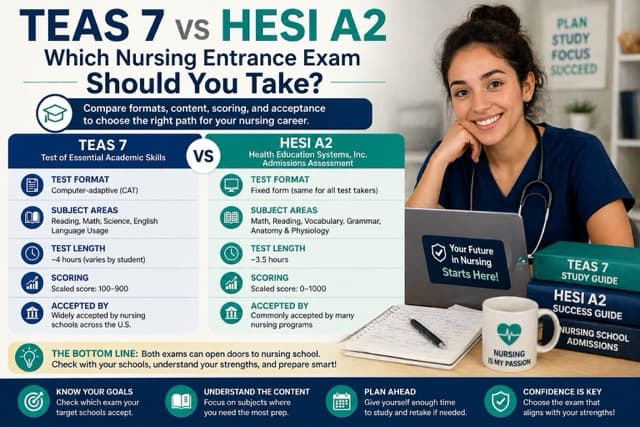
Let's start with the rapid-fire version, because you probably don't have time to read 3,000 words before deciding which exam to register for. Here's what most students need to know upfront about TEAS vs HESI exam differences:
- TEAS 7 (ATI TEAS): 170 questions across 4 sections (Reading, Math, Science, English). Created by ATI Testing. Around 209 minutes total. Used by most ADN and BSN programs.
- HESI A2: Up to 326 questions across 8 possible sections (Reading, Vocabulary, Grammar, Math, Biology, Chemistry, Anatomy & Physiology, Critical Thinking). Created by Elsevier. Schools choose which sections you take. Often 4-5 hours.
- Cost: TEAS runs $70-$115. HESI A2 typically costs $35-$100 depending on your school's setup.
- Difficulty: Most students say HESI A2 is harder because of the extra science sections. But TEAS 7 reading and math can trip up students who underestimate it.
Quick answer to "which is easier the TEAS or HESI?" - it honestly depends on your strengths. Strong in biology and chemistry? HESI might feel manageable. Better at reading comprehension and applied math? TEAS could be your friend.
What Is the TEAS 7 Exam?
The TEAS - Test of Essential Academic Skills - is a standardized entrance exam used by thousands of nursing and allied health programs across the US and Canada. Currently in its 7th edition (TEAS 7, released in 2022), it's developed by ATI Nursing Education.
The TEAS 7 has four sections:
- Reading (45 questions, 55 minutes): Key ideas, craft and structure, integration of knowledge. You'll analyze passages and identify main ideas.
- Math (38 questions, 57 minutes): Numbers, algebra, measurement, data interpretation. Calculator provided on-screen.
- Science (50 questions, 60 minutes):Anatomy and physiology dominates here (about half the section), plus general biology, chemistry, and scientific reasoning.
- English & Language Usage (37 questions, 37 minutes): Grammar, sentence structure, vocabulary, and language knowledge.
What's the difference between TEAS 6 and 7? The newer version added question types like ordered response, hot-spot questions (clicking a specific area on an image), and "select all that apply" formats. Math no longer includes a separate algebra-heavy section - it integrates algebra throughout applied problems. Honestly? TEAS 7 feels more like real nursing school problem-solving than TEAS 6 did.
If you're prepping for this exam, our TEAS exam services and Fast TEAS Pass tutoring can shortcut a lot of the trial and error.
What Is the HESI A2 Exam?
The HESI A2 - Health Education Systems, Inc. Admission Assessment - is published by Elsevier and used heavily by BSN programs, especially competitive ones. Where the TEAS is fixed at 4 sections, the HESI A2 has 8 possible sections, and your school picks which ones you take.
Here's what's available on the HESI A2:
- Reading Comprehension - 47 questions about healthcare-related passages.
- Vocabulary & General Knowledge - 50 questions, leans heavily on medical and healthcare terms.
- Grammar - 50 questions on sentence structure, parts of speech, common errors.
- Basic Math Skills - 50 questions covering arithmetic, fractions, ratios, conversions. Often has healthcare-context word problems (medication dosages, IV rates).
- Biology - 25 questions on cells, genetics, biological processes.
- Chemistry - 25 questions on matter, reactions, atomic structure.
- Anatomy & Physiology - 25 questions on body systems and structures.
- Critical Thinking - 30 questions, often not scored but used for placement.
Most schools require 4-6 sections. A typical BSN program might require Reading, Vocabulary, Grammar, Math, Biology, and A&P. That's why you'll hear HESI A2 prep horror stories - it's not unusual to spend 4-5 hours actively testing.
Need help prepping? Check out our HESI exam preparation services and Fast HESI A2 Pass tutoring program for personalized coaching.
Content Differences Between TEAS and HESI
Now let's dig into the meat of the TEAS vs HESI A2 comparison. Both exams test similar foundational skills, but the way they test them differs quite a bit.
Reading: TEAS reading focuses on academic passages and pulls broadly from various subjects. HESI reading uses healthcare-themed passages exclusively. If you're already familiar with medical contexts, HESI reading feels more relevant. If you prefer general academic reading, TEAS might feel more comfortable.
Math: Hesi math vs teas math is closer than most students think. Both cover arithmetic, fractions, decimals, percentages, ratios, basic algebra, and measurement. HESI tilts toward applied healthcare math (drug calculations, ratios, conversions). TEAS leans more academic with data interpretation and measurement context. Both provide on-screen calculators, though some HESI sections restrict it.
Science: This is where the biggest difference shows up. TEAS bundles all science into one section (50 questions, mostly A&P). HESI splits science into separate Biology, Chemistry, and Anatomy & Physiology sections - each with 25 dedicated questions. If your school requires all three HESI science sections, you'll face 75 science questions vs the TEAS's 50. More breadth, more depth.
English: TEAS English & Language Usage and HESI Grammar overlap significantly. Both test sentence structure, punctuation, parts of speech, and common usage errors. HESI also has a separate Vocabulary section that's heavy on medical terminology - a section TEAS doesn't have.
Question style: TEAS 7 includes newer question formats (ordered response, hot-spot, multi-select). HESI sticks mostly with traditional multiple choice. Some students find TEAS 7's variety harder to navigate; others appreciate the format mixing things up.
Need a Boost on Your Nursing Entrance Exam?
Whether you're tackling TEAS or HESI, our expert tutors create targeted study plans that focus on your weakest areas. Get the score you need to land your nursing school spot.
TEAS or HESI: Which Is Harder?
Honestly? This is the question students Google more than any other in the TEAS vs HESI debate. The Reddit threads, the AllNurses forums, the Quora posts - everyone wants to know: is TEAS or HESI harder?
The short answer: most students find HESI A2 harder overall, but it's not a slam dunk.
Here's why HESI tends to feel harder:
- More sections = more content to master. Six sections of HESI is a lot more material than four sections of TEAS.
- Separate Chemistry and Biology sections require deeper subject-specific knowledge. The TEAS science section samples broadly without going as deep.
- Vocabulary section weighted toward medical terminology students haven't encountered yet.
- Longer total testing time means more mental fatigue.
But here's where TEAS can surprise people. The reading passages are denser than students expect. The math integrates algebra in ways some test-takers don't anticipate. And TEAS 7's newer question types (drag-and-drop, ordered response) catch students off guard if they trained on TEAS 6 materials.
Reddit threads about teas vs hesi which one is easier reddit threads usually agree on this: it depends on your background. Recent biology and chemistry coursework? HESI feels manageable. Strong English and reading skills with weak science? TEAS will treat you better.
Scoring, Cost, and Logistics
Numbers matter. Let's talk about what you'll actually pay, what scores you need, and how the logistics differ.
Scoring:
- TEAS 7 reports a percentage score plus a "level" rating: Below Proficient, Basic, Proficient, Advanced, Exemplary. Most competitive programs want Proficient or higher (around 65-78%). Top programs require 80%+.
- HESI A2 reports percentage scores per section. Most schools want 75%+ on each required section. Accelerated BSN programs sometimes require 85% or 90%+. There's also a composite score that averages your sections.
Cost:
- TEAS: $70 if taken at a school's testing center, up to $115 at PSI testing centers. Online proctored TEAS runs around $115 too.
- HESI A2: Varies wildly by school. Some charge $35-$50, others charge $80-$100. Some schools build the cost into application fees.
Retake policies: TEAS lets you retake every 30 days, with a typical limit of 3 attempts per year per program. HESI retake rules vary by school - some let you retake after 30 days, others only allow one retake per application cycle. Check before assuming you can try again.
Where you take it: Both exams can be taken at school testing centers, third-party centers (PSI for TEAS), or remote-proctored online. The remote option helps if you're in a rural area, but it adds technical headaches. Test your equipment thoroughly first.
Considering your full nursing exam journey? Our nursing exam services cover everything from entrance tests to NCLEX prep.
How to Choose Between TEAS and HESI
Step one - and this can't be repeated enough - check your nursing program's admission requirements. The TEAS vs HESI question is usually answered for you by the school.
But what if you have flexibility? Maybe you're applying to multiple programs, or your target school accepts either. Here's a decision framework:
Choose TEAS if:
- Your program is an ADN (associate degree in nursing) or a state community college BSN.
- You want fewer sections to study for.
- Your science background is shaky and you'd prefer a single science section over three.
- You're applying to multiple schools - TEAS is more widely accepted than HESI.
Choose HESI if:
- Your target program is a competitive 4-year BSN or accelerated BSN.
- You're confident in biology, chemistry, and A&P (recent coursework helps).
- You want to demonstrate depth in healthcare-related knowledge.
- Your school requires it, period.
And listen - if a school accepts either, ask current students which they took. Sometimes schools have unofficial preferences even when their policy says "either is fine." Real-world feedback beats official paperwork most of the time.
Study Strategies for Either Exam
Whether you're tackling TEAS 7 or HESI A2, the strategies that work are surprisingly similar. Here's what actually moves the needle:
1. Take a diagnostic test first. Don't start studying blind. Take an official practice test and identify your weakest sections. Spend 60% of your study time on those weak spots, 30% on medium-strength areas, and 10% maintaining your strong sections.
2. Use the official prep materials. ATI's TEAS Study Manual and Elsevier's HESI A2 Study Guide are written by the test makers. Yes, they cost money. Yes, they're worth it. Free YouTube videos and Quizlet decks help supplement, but they shouldn't be your foundation.
3. Practice with timing pressure. Both exams penalize slow test-takers. The TEAS gives you 209 minutes for 170 questions - that's barely 73 seconds per question. Practice with a timer from day one.
4. Master medical math early. Both exams test fractions, decimals, percentages, ratios, and measurement conversions. The HESI especially leans into medication-dosage scenarios. Spend extra time on these. They show up everywhere - on the entrance exam, then again on the NCLEX.
5. Build your science vocabulary systematically. Anatomy and physiology terms, biology basics, chemistry fundamentals - flashcards with spaced repetition (Anki, Quizlet) work better than rereading textbooks. Twenty minutes daily beats four-hour weekend cram sessions.
6. Take full-length practice tests. The HESI A2 can run 4-5 hours. If you've never sat through that marathon, test day will exhaust you. Build mental stamina by doing at least 2-3 full-length practice runs in the final weeks.
7. Get help if you're stuck. Self-study works for some students. For others, a tutor catches blind spots in days that would take months alone. Our Fast TEAS Pass tutoring and Fast HESI A2 Pass tutoring programs are built for people who need to pass quickly and on the first try.
Bottom line on TEAS vs HESI: pick the one your school requires (or the one that matches your strengths if you have the choice), commit to 8-12 weeks of structured prep, use official materials, and don't skip the science review. With the right plan, either exam is absolutely beatable - and nursing school is closer than you think.
Frequently Asked Questions
Are TEAS and HESI the same exam?
No, TEAS and HESI are not the same. The ATI TEAS (currently version 7) and the HESI A2 are two different nursing entrance exams created by different companies. Most schools accept one or the other, not both. They cover similar topics - reading, math, science, English - but the questions, format, and scoring differ.
Is TEAS or HESI harder?
Most students say the HESI A2 is harder overall, mainly because it includes more sections (anatomy and physiology, biology, chemistry) and asks more detailed science questions. The TEAS 7 tends to feel more straightforward, with broader content and clearer question wording. That said, students who are stronger in critical reading and reasoning sometimes find TEAS trickier than expected.
Which nursing exam should I take, TEAS or HESI?
You usually don't choose - your nursing school chooses for you. Check your program's admissions page first. If a school accepts either, pick TEAS if you prefer fewer sections and broader topics, or HESI if you're confident in science and want to showcase deeper subject knowledge.
What is the difference between TEAS 6 and TEAS 7?
TEAS 7 (released in 2022) replaced TEAS 6 with updated content, new question types like ordered response and hot-spot questions, and refreshed math standards (no more algebra-only focus). The total number of questions is similar, but TEAS 7 emphasizes critical thinking and real-world nursing scenarios more directly.
Can I take both the TEAS and HESI?
Yes, you can take both, and some applicants do when applying to multiple schools with different requirements. But it's a lot of prep. If you have a target school, focus your time on the one they require rather than splitting effort.
What's a passing score for TEAS vs HESI?
There's no single passing score for either exam - schools set their own minimums. For TEAS, competitive programs typically want 65-78% or higher. For HESI A2, most schools want 75-80% or above, with some requiring 90%+ for accelerated programs. Always check your specific program's cutoff.
How long should I study for TEAS or HESI?
Plan on 6-12 weeks of consistent prep. If your science background is weak, lean toward 12 weeks. Strong students with recent coursework can prepare in 4-6 weeks. Either way, daily practice beats marathon weekend cram sessions every time.
Are TEAS and HESI math sections the same?
Pretty similar in topics - both cover basic algebra, fractions, decimals, percentages, ratios, and measurement conversions. HESI math leans slightly more applied and includes some healthcare-context word problems. TEAS math feels a bit more academic but covers the same core skills.
Do TEAS and HESI scores expire?
Most nursing programs accept TEAS and HESI scores up to 2 years old, though some accept results up to 3 years old. Check your school's specific policy before retaking unnecessarily.
Can I get help passing TEAS or HESI?
Absolutely. Tutoring, prep courses, and structured study guides make a huge difference. If you're juggling work, family, or other commitments, professional support can compress your prep timeline and target your weak areas more efficiently than self-study alone.