
The nursing shortage 2026 conversation can sound gloomy at first: hospitals stretched thin, older nurses retiring, patients waiting longer, and schools turning away qualified applicants because they do not have enough faculty or clinical placement capacity. True enough. But if you are thinking about a healthcare career, there is another side to the story. Opportunity. A lot of it.
This does not mean nursing is an easy backup plan. It is not. Nursing asks for science, stamina, judgment, emotional steadiness, and the ability to keep thinking when everyone around you is anxious. Still, if you have been wondering whether to become a nurse now, the timing is unusually strong. Employers need nurses. Communities need nurses. And the career ladder is far more flexible than many people realize.
In this guide, we will look at what the shortage actually means, which nursing jobs are in demand, where healthcare career opportunities are expanding, and how to move from curiosity to a real plan. We will also talk about the TEAS, HESI, nursing school applications, and the mistakes that can quietly slow people down.
Why the Nursing Shortage Matters in 2026
The nursing shortage 2026 outlook is not just a headline. It is the result of several pressures arriving at once. The U.S. population is aging. Chronic illness is common. Hospitals are caring for sicker patients. Long-term care facilities need more hands. At the same time, many experienced nurses are retiring or stepping away from bedside roles after years of burnout.
Then there is the education bottleneck. Nursing schools can only admit as many students as they can safely train, and that depends on instructors, lab space, clinical sites, preceptors, and budgets. So yes, you may see thousands of open nursing jobs while also hearing that nursing programs are competitive. Both can be true. Weird? A little. But that is healthcare.
For career seekers, the practical takeaway is simple: demand is real, but credentials still matter. You cannot walk into a hospital and say, "I am helpful, give me a badge." You need the right training, the right license, and often the right entrance exam score before you even get into the program that gets you to the license.
That is where planning pays off. If you are looking at nursing because you want stable work, meaningful patient contact, and a career that travels well across state lines, the shortage can work in your favor. But the people who benefit most are the ones who treat the process like a sequence: prerequisites, admissions test, program, licensure, first specialty, then growth.
What the Shortage Actually Means for Career Seekers
When people ask, "Is there a nursing shortage?" they usually want to know one of three things. Will I find a job? Will the pay be worth it? And will I have options if I do not want to work in the same hospital unit forever?
The short answer is yes, probably, and absolutely. The nursing job outlook remains strong because healthcare is not optional. People need surgery, medications, vaccinations, prenatal care, rehabilitation, mental health support, hospice care, school health services, and chronic disease management whether the economy is booming or limping along.
A shortage also changes the conversation around benefits. In competitive markets, employers may offer sign-on bonuses, tuition assistance, loan repayment, residency programs for new grads, flexible scheduling, weekend differentials, relocation support, and internal pathways into specialty units. Not every job will be generous. Some postings look shiny and feel rough once you read the fine print. Still, nurses in 2026 have more leverage than workers in many fields.
There is a catch, naturally. The shortage does not eliminate the need to be prepared. Nursing school can be academically intense, especially for students who have been away from math and science for years. If your program requires the TEAS or HESI A2, a weak score can delay your application even when your motivation is sky high. If you already know nursing is the goal, start lining up support early. Review prerequisites, compare programs, and get honest about your testing gaps.
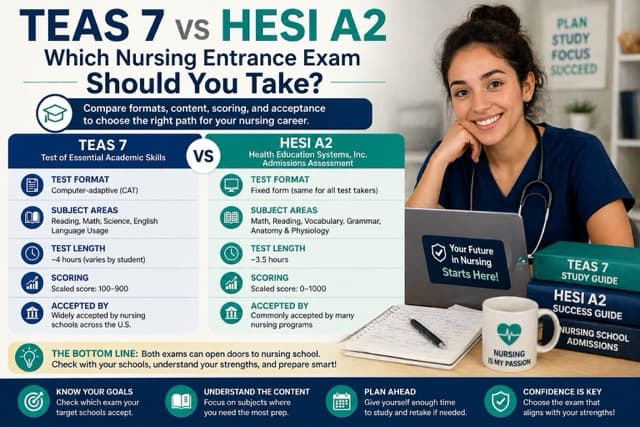
If your first hurdle is admission, our Fast TEAS Pass tutoring and Fast HESI A2 Pass tutoring pages are useful next stops. And if you are comparing the two tests, read TEAS vs HESI for nursing entrance exams before you buy the wrong prep materials.
Nursing Jobs in Demand Right Now
The phrase "nursing jobs in demand" covers a wide field. Bedside hospital roles get the most attention, but the shortage touches almost every corner of care. If you are mapping your path, it helps to know where the pressure is strongest.
Registered Nurses
Registered nurses remain the backbone of the clinical workforce. RNs assess patients, administer medications, coordinate care, educate families, communicate with providers, and notice the small changes that can prevent a crisis. The RN path usually requires an ADN or BSN, followed by passing the NCLEX-RN.
Licensed Practical Nurses
LPNs, called LVNs in some states, are especially important in long-term care, rehab, clinics, home health, and physician offices. This route can be faster than becoming an RN, and it can be a practical entry point if you want patient care experience before deciding whether to bridge into an RN program.
Specialty Nurses
ICU, emergency, labor and delivery, operating room, oncology, dialysis, and psychiatric nursing all have strong demand in many regions. These roles often require experience, specialty training, and a willingness to keep learning. They can also pay more through differentials or specialty incentives.
Nurse Practitioners and Advanced Practice Roles
Advanced practice roles require graduate education, but they are worth understanding early. Nurse practitioners, nurse anesthetists, and nurse midwives can diagnose, prescribe, and manage care within state scope-of-practice rules. If you like the idea of long-term autonomy, primary care, anesthesia, women's health, or mental health, nursing can lead there.
And no, you do not need to pick your final specialty on day one. Many nurses start in medical-surgical, long-term care, or a residency program, then move as they discover what kind of work fits their temperament. That flexibility is one of the best parts of the profession.
Healthcare Career Opportunities Beyond the Hospital Floor
If your picture of nursing is only a hospital hallway at 3 a.m., widen the lens. Hospital work is important, and plenty of nurses love it. But healthcare career opportunities for nurses now stretch into places that might surprise you.
Public health departments need nurses for immunization programs, outbreak response, maternal health, and community education. Schools need nurses who can manage medications, respond to emergencies, support students with chronic conditions, and coordinate with families. Insurance companies hire nurses for case management, utilization review, and care coordination. Technology companies hire nurses for clinical product roles, telehealth workflows, documentation, quality review, and patient education.
Home health and hospice are also growing as more patients receive care outside the hospital. These roles require independence and strong communication because you may be the clinician who sees the full picture in a patient's home. It is not easier work, exactly. It is different work. More autonomy, more driving, more family teaching, and often a deeper view of how illness affects daily life.
This is why "become a nurse now" is not just advice for people who want bedside shifts forever. A nursing license can be a platform. You can move into education, leadership, informatics, infection prevention, legal nurse consulting, research coordination, occupational health, or advanced practice later. The first license opens the door; your interests shape what happens next.
Preparing for a Nursing Entrance Exam?
A strong TEAS or HESI score can move your nursing application from possible to competitive. Get targeted support before the deadline gets loud.
Education Paths: CNA, LPN, ADN, BSN, and Beyond
One reason nursing attracts career changers is that it has entry points. You do not have to leap straight into a four-year plan if that does not fit your money, schedule, or family responsibilities.
CNA: Fast Clinical Exposure
Certified nursing assistant programs can be short and relatively affordable. CNAs help with daily care, mobility, bathing, feeding, vital signs, and patient comfort. This role is physically demanding, but it gives you a close look at the realities of care. For some students, CNA work confirms that nursing is right. For others, it prevents an expensive wrong turn. Both outcomes are useful.
LPN/LVN: A Practical License With Bridge Options
LPN programs often take about a year, though timelines vary. Many graduates work in long-term care, outpatient clinics, home health, or rehab. Some later bridge from LPN to RN. If you need to earn sooner, this path may make sense, but check your local job market first. Scope and pay vary by state and employer.
ADN: A Common RN Route
An Associate Degree in Nursing can lead to RN licensure after passing the NCLEX-RN. Community colleges often offer ADN programs at lower tuition than universities, but waitlists can be serious. Many ADN-prepared nurses later complete RN-to-BSN programs while working.
BSN and Accelerated BSN
A Bachelor of Science in Nursing is preferred by many hospitals and may be required for certain leadership, specialty, or magnet hospital roles. If you already have a bachelor's degree in another field, an accelerated BSN can be a strong option. These programs move quickly, so do not underestimate the workload. Fast does not mean gentle.
If you want a deeper career-change walkthrough, our career change to nursing guide breaks down prerequisites, timelines, and age concerns in more detail.
Entrance Exams: TEAS, HESI, and Nursing School Readiness
Nursing shortages do not make nursing schools ignore academic readiness. Most programs still want proof that you can handle reading-heavy material, dosage calculations, anatomy, physiology, grammar, and timed test pressure. That is why the TEAS and HESI A2 matter so much.
The TEAS usually covers Reading, Math, Science, and English. The HESI A2 can include Anatomy and Physiology, Biology, Chemistry, Vocabulary, Grammar, Reading Comprehension, and Math, depending on what your school requires. They are not the same test. Similar universe, different furniture.
If you have been out of school for a while, do not panic. Many adult learners score well after focused review. The mistake is trying to study everything equally. You do not need to become a walking textbook. You need to identify the sections your program weighs most heavily, diagnose your weak areas, and practice under timed conditions until the format feels familiar.
For direct support, see take my TEAS exam, take my HESI exam, and take my nursing exam resources. If you are already enrolled and worried about course exams, the nursing exam preparation tips article is a practical next read.
RN Shortage by State: How Location Changes Your Options
Search interest around RN shortage by state is high because people want a clean ranking. Fair enough. But the real answer is more layered than a top-ten list. Shortages depend on the type of facility, specialty, rural access, local wages, licensing rules, cost of living, school output, and how many nurses are near retirement.
A state can have plenty of nurses in one city and serious gaps in rural counties. A hospital can be fully staffed on day shift and desperate for experienced night nurses. Long-term care may be under pressure even when a nearby hospital has a steady supply of new graduates. So when you compare states, look at actual job postings, state workforce reports, hospital residency programs, and local nursing forums with a skeptical eye.
Compact licensure also matters. The Nurse Licensure Compact can make cross-state work easier for eligible nurses in participating states, which is helpful for travel nursing, telehealth, relocation, and border-region employment. Rules change, though, so verify the current board of nursing requirements before building your plan around mobility.
If you are flexible about location, shortage areas can create real openings. Rural hospitals, correctional health, tribal health, behavioral health, dialysis centers, and long-term care facilities may offer faster hiring than prestigious urban specialty units. That first job can become the bridge to everything else.
Your 2026 Action Plan for Becoming a Nurse
The nursing shortage 2026 landscape creates opportunity, but opportunity still needs a calendar. Here is a practical path you can start this week.
- Pick your target role. Decide whether you are exploring CNA, LPN, ADN, BSN, or accelerated BSN. You can change later, but you need a working target.
- Choose three local programs. Compare prerequisites, entrance exams, application dates, tuition, clinical placements, NCLEX pass rates, and accreditation.
- Audit your transcripts. Identify missing prerequisites and expired science courses. Ask admissions offices how they evaluate older credits.
- Plan your entrance exam. Confirm whether each school requires TEAS, HESI A2, or another assessment. Build a 6-8 week study schedule if your deadline allows it.
- Get patient exposure. Volunteer, shadow, or work as a CNA, medical assistant, patient care tech, or unit clerk if possible. Even a little exposure helps your application and your confidence.
- Budget honestly. Include tuition, books, uniforms, background checks, immunizations, exam fees, transportation, childcare, and reduced work hours.
- Build your support system. Nursing school is not a solo sport. Talk with family, employers, mentors, and classmates before the pressure hits.
If you want a broader study framework, the HESI A2 study tips and TEAS exam study guide can help you organize the admissions-test piece without wasting weeks on low-value review.
Common Mistakes to Avoid When Chasing a Nursing Career
A lot of smart future nurses lose time because they move with enthusiasm before they have the details. The first mistake is assuming every nursing program has the same prerequisites. They do not. One school may require Chemistry with lab. Another may not. One may accept online Anatomy and Physiology. Another may reject it. Read every admissions page like it is a contract.
The second mistake is underestimating the entrance exam. The TEAS and HESI are not impossible, but timed science and math questions can humble even capable adults. If your dream program gives admission points for a high score, treat test prep as part of the application, not an afterthought.
The third mistake is choosing a program only because it is fast. Fast can be wonderful. Fast can also mean expensive, exhausting, and unforgiving. Look for completion rates, licensure pass rates, clinical quality, student support, and whether graduates actually get hired in the settings you care about.
Finally, do not romanticize the shortage. Yes, the nursing shortage 2026 reality creates leverage. But nurses are not interchangeable bodies on a schedule. Good nursing requires competence, humility, boundaries, and teamwork. If you are drawn to the profession for the right reasons and prepare carefully, this can be the start of a durable, deeply useful career.
And honestly? Healthcare needs people who have lived a little. Former teachers, parents returning to school, veterans, service workers, office professionals, caregivers, analysts, and career changers often bring exactly the calm, empathy, and real-world judgment patients remember. The door is not magically open. But it is openable.