
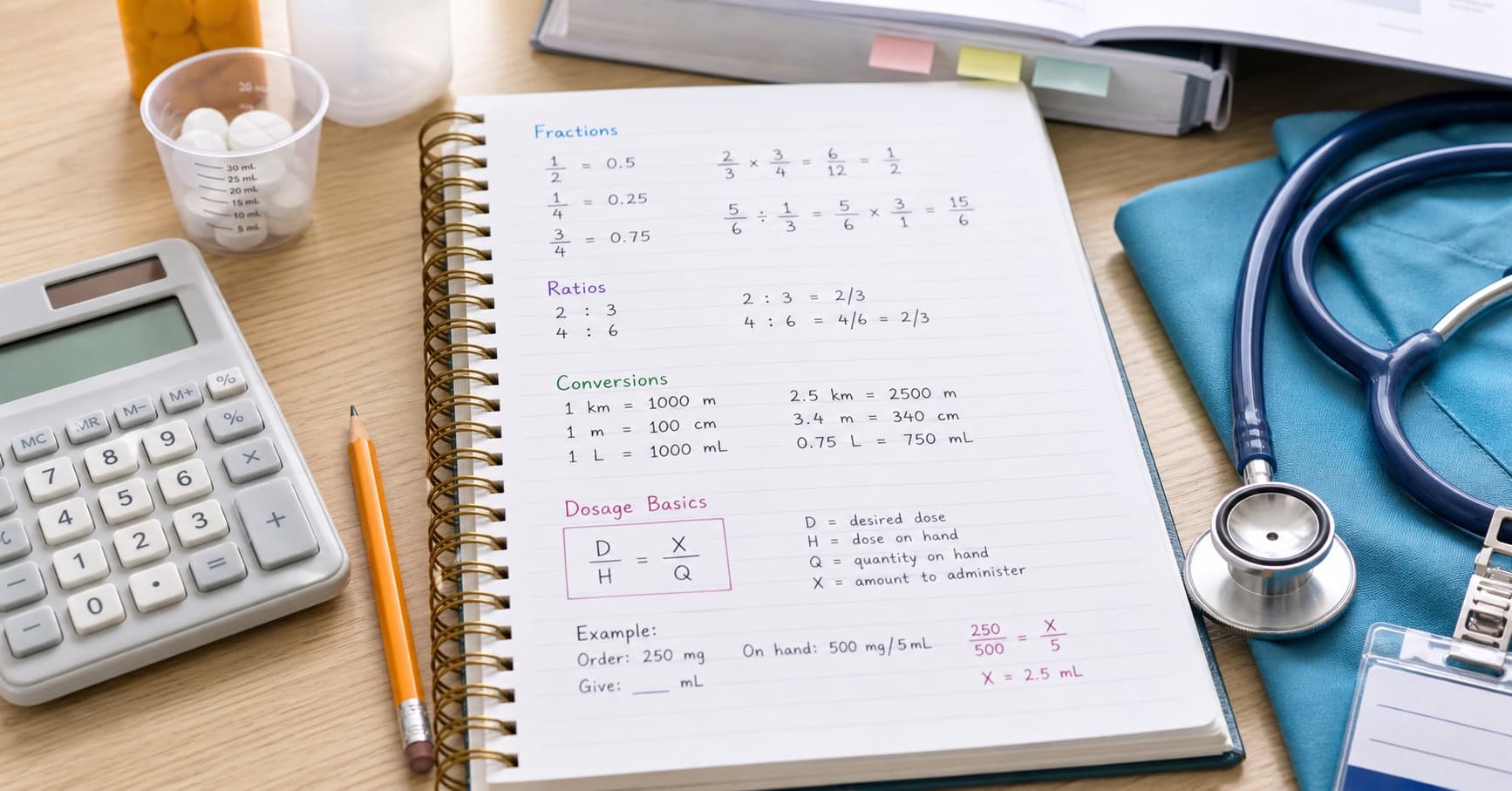
HESI A2 math practice can feel weirdly personal. You may be great with patients, organized in lab, and serious about nursing school, then one fraction problem shows up and your brain suddenly acts like it has never seen a denominator in its life.
That is more common than students admit. The HESI A2 math section is not trying to test calculus or advanced statistics. It is testing practical number sense: fractions, ratios, proportions, conversions, percentages, and the kind of dosage setup that future nurses need to read carefully. Simple skills. High pressure.
This guide gives you a clear HESI math study guide without turning the whole thing into a textbook. You will see what to expect, how to practice, where students lose points, and how to work through sample setups calmly. If you are also planning the rest of your test prep, bookmark our broader HESI A2 study tips guide for the reading, grammar, vocabulary, and science sections.
What to Expect on HESI A2 Math
Most HESI A2 math sections include about 50 questions, though your exact testing experience depends on your school. The content is usually middle-school and early high-school math dressed up in healthcare language. That last part matters. A question about 0.75 looks easy until it is attached to milliliters, tablets, or a patient chart.
The highest-yield HESI A2 math topics usually include:
- Adding, subtracting, multiplying, and dividing fractions
- Changing fractions to decimals and percentages
- Ratios, proportions, and rates
- Metric and household measurement conversions
- Basic algebra with one unknown
- Word problems involving money, time, units, and dosage
The math is usually multiple choice, but do not treat it like a guessing game. HESI answer choices often include the result you would get if you flipped a ratio, skipped a conversion, or moved a decimal one place too far. If you have ever looked at four answer choices and thought, "Honestly, three of these seem possible," that is probably what happened.
A good prep plan is not just doing a printable HESI A2 math practice test once and hoping for the best. Practice tests are useful, sure. But your real score jump comes from spotting patterns in your mistakes and repeating the exact skill until your setup gets cleaner.
Start With a Simple HESI A2 Math Practice Plan
The fastest way to waste a week is to study everything with the same intensity. You do not need equal time on skills you already know. Start with a short diagnostic set: 10 fraction questions, 10 ratio or proportion questions, 10 conversion questions, and 10 mixed word problems. Time yourself, but do not obsess over speed yet.
When you grade the set, sort every missed question into one of four buckets:
- Concept gap: You did not know what skill the question was testing.
- Setup error: You knew the skill but wrote the ratio, fraction, or equation wrong.
- Arithmetic slip: The setup was fine, but the calculation went sideways.
- Reading mistake: You missed a word like "per," "remaining," "total," "each," or "twice."
That bucket list turns vague anxiety into a real plan. Maybe you do not need "more math." Maybe you need two evenings on HESI A2 ratios and one focused session on metric conversions. Much less dramatic. Much more useful.
If your exam date is close, use a 60/30/10 split. Spend 60% of study time on your weakest tested skill, 30% on mixed review, and 10% on quick mental math. Students with more time can stretch this into four to six weeks, but the idea is the same: practice what costs you points.
Fractions, Decimals, and Percentages
HESI A2 fractions scare people because they are easy to rush. The rules are simple, but the wrong rule at the wrong time wrecks the answer. Adding fractions needs a common denominator. Multiplying fractions does not. Dividing fractions means multiply by the reciprocal. Tiny rule, massive difference.
Try this common style of problem:
Example: Add 2/3 + 1/4.
Common denominator: 12. Convert 2/3 to 8/12 and 1/4 to 3/12.
Add: 8/12 + 3/12 = 11/12.
Now compare that with multiplication:
Example: Multiply 2/3 x 1/4.
Multiply straight across: 2 x 1 = 2 and 3 x 4 = 12, so the answer is 2/12, simplified to 1/6.
Percentages are the same story. They look familiar, so people get casual. Remember that percent means "per 100." To change a percent to a decimal, move the decimal two places left. To change a decimal to a percent, move it two places right.
- 75% = 0.75 = 3/4
- 12.5% = 0.125 = 1/8
- 0.2 = 20% = 1/5
Memorize common conversions like these. They show up constantly in HESI A2 math practice questions, and knowing them saves time. If you have to calculate every single fraction-decimal-percentage relationship from scratch, the clock starts feeling louder than it should.
For a deeper general math refresher, our guide on how to pass a math exam covers test-taking habits that also work well for HESI math.
Ratios and Proportions
Ratios compare quantities. Proportions say two ratios are equal. That is it. The problem is that HESI A2 ratios often arrive inside sentences, so students have to translate words into math before they can solve anything.
A ratio like 2 nurses for every 9 patients can be written as 2:9, 2 to 9, or 2/9. If a question asks how many nurses are needed for 36 patients at the same ratio, set it up like this:
Example: 2 nurses / 9 patients = x nurses / 36 patients
Cross multiply: 9x = 72.
Solve: x = 8 nurses.
Notice the labels. Nurses stay on top. Patients stay on bottom. When your units line up, the math usually behaves. If you flip one side, you may still get an answer from the calculator, but it will not mean the right thing.
This is why proportions are a bridge into dosage work. The same setup appears again and again: available amount relates to available volume, ordered amount relates to unknown volume. You are not learning a brand-new skill when you reach medication math. You are applying the same ratio habit in a clinical context.
Need Focused Help With HESI Math?
If fractions, ratios, or dosage setup keep tripping you up, targeted tutoring can turn scattered review into a clear score plan.
Measurement Conversions You Should Know
HESI A2 math conversion practice deserves its own study block. Conversions are not difficult once memorized, but they are unforgiving. One missed zero can turn a reasonable answer into something wildly unsafe.
Start with the metric ladder:
- 1 kilogram = 1,000 grams
- 1 gram = 1,000 milligrams
- 1 milligram = 1,000 micrograms
- 1 liter = 1,000 milliliters
- 1 meter = 100 centimeters
- 1 centimeter = 10 millimeters
Then add the household conversions your program may expect:
- 1 tablespoon = 3 teaspoons
- 1 tablespoon = 15 mL
- 1 teaspoon = 5 mL
- 1 ounce = 30 mL for many nursing-school problems
- 1 cup = 8 ounces
Always use the conversion values your course, school, or testing guide provides. Nursing programs sometimes teach a standard approximation for entrance-exam purposes, even when a more exact scientific conversion exists. On test day, use the expected test convention.
Example: Convert 2.5 liters to milliliters.
Since 1 liter = 1,000 mL, multiply 2.5 x 1,000 = 2,500 mL.
The best HESI A2 math practice here is quick and repetitive: 15 conversions a day for a week. Mix large-to-small and small-to-large units so you do not only memorize one direction. Say the direction out loud if it helps. Larger unit to smaller unit? Multiply. Smaller unit to larger unit? Divide.
Dosage Calculation Basics for Beginners
HESI dosage calculations can sound intimidating, especially if you have not taken nursing pharmacology yet. For entrance-exam math, keep it basic. You are usually solving for how much to give based on what is ordered and what is available.
A simple proportion format works beautifully:
Ordered dose / Available dose = Amount to give / Quantity available
Example: The order is 250 mg. The medication available is 500 mg per 2 mL. How many mL should be given?
Set up: 250 mg / 500 mg = x mL / 2 mL.
Cross multiply: 500x = 500.
Solve: x = 1 mL.
Here is a tablet example:
Example: The order is 100 mg. Tablets available are 50 mg each. How many tablets?
100 mg / 50 mg = x tablets / 1 tablet. Solve x = 2 tablets.
The math is short. The reading is the real trap. If the order is in grams and the medication label is in milligrams, convert first. If a question asks for teaspoons and the available dose is in milliliters, convert at the end. Do not combine everything in your head and hope it lands.
If your score goal is high or your exam is coming fast, a structured review can help. Our Fast HESI A2 Pass tutoring focuses on weak areas like fractions, conversions, and dosage setup instead of making you sit through content you already know. Students who need broader support can also review our HESI exam services for options around planning and preparation.
How to Handle HESI A2 Math Word Problems
Word problems are where students who "know the math" still lose points. Not because they cannot divide. Because they start dividing before they know what the question is asking. Slow down at the beginning so you can speed up later.
Use this four-step method:
- Circle what the question wants.
- Underline the numbers and units.
- Write the relationship in words before symbols.
- Estimate the answer before choosing an option.
Estimation is underrated. If a dosage answer says 40 tablets, your common sense should tap the brakes. If a conversion says 0.003 mL for a normal spoon-sized amount, pause. The HESI will not always give absurd answers, but many wrong choices are far enough from reality that estimation can save you.
Example: A patient drinks 3 cups of water. How many ounces is that?
Relationship: 1 cup = 8 ounces.
Calculate: 3 x 8 = 24 ounces.
This may look too easy while you are reading calmly on a screen. Under test pressure, though, students mix cups and ounces, multiply when they should divide, or answer in the wrong unit. That is why your HESI A2 math practice should include timed mixed sets, not only topic-by-topic drills.
If testing anxiety is part of the problem, you are not broken. You are having a normal stress response. Our test anxiety guide can help you build a calmer routine before exam day.
Your Final Week Review Routine
The final week is not the time to collect every free HESI A2 math practice PDF on the internet. It is the time to tighten your process. Use one reliable set of materials, review your mistake log, and practice under conditions that look like test day.
Try this seven-day rhythm:
- Day 1: Full mixed math practice test with timing.
- Day 2: Fractions, decimals, and percentages review.
- Day 3: Ratios, proportions, and basic algebra.
- Day 4: Metric, household, and time conversions.
- Day 5: Dosage calculation basics and unit matching.
- Day 6: Second mixed practice test, then review every missed question.
- Day 7: Light review, formula sheet, sleep, and test-day prep.
Do not turn the night before into a marathon. A tired brain makes sloppy math mistakes. Pack what you need, review your testing rules, and read our test day checklist so you are not dealing with logistics at the last minute.
One last thing: do not judge your nursing potential by how rusty your fraction skills feel today. HESI A2 math practice is a skill-building process, not a character verdict. Start with the patterns that cost you points, review them honestly, and keep the work practical. Fractions, ratios, conversions, and dosage basics are beatable.
For a broader nursing-test plan, read our nursing exam preparation tips. The math section matters, but it is only one piece of a strong application strategy.
Frequently Asked Questions
What math is on the HESI A2?
HESI A2 math usually covers arithmetic, fractions, decimals, percentages, ratios, proportions, measurement conversions, basic algebra, and healthcare-style word problems. Some schools emphasize dosage calculations more than others, so check your program's required sections before you study.
Is the HESI A2 math hard?
HESI A2 math is not advanced, but it can feel hard because the questions are timed and often written as word problems. Most students struggle more with fractions, conversions, and ratio setup than with complex formulas.
Is HESI A2 math multiple choice?
Yes, HESI A2 math is primarily multiple choice. You still need to show yourself the setup on scratch paper because answer choices often include common mistakes, such as flipped ratios or misplaced decimals.
Can I use a calculator on the HESI A2 math section?
The HESI A2 usually provides a basic on-screen calculator for the math section, but policies can vary by testing site and school. Do not rely on a calculator for every step. Practice mental estimation, fraction setup, and decimal placement so you can catch obvious errors.
What is the best way to study HESI A2 fractions?
Practice converting mixed numbers, simplifying fractions, finding common denominators, and switching between fractions, decimals, and percentages. The fastest improvement usually comes from doing short sets every day and reviewing every missed step.
How many HESI A2 math practice questions should I do?
Aim for at least 250 to 400 focused math questions before test day if math is a weak area. More important than the total number is your review process. Keep a mistake log and repeat similar problems until the setup feels automatic.
Are HESI dosage calculations difficult?
Basic HESI dosage calculations are manageable once you learn the proportion format: ordered dose over available dose equals amount to give over quantity available. The trick is reading units carefully and converting before you calculate.
Do I need algebra for HESI A2 math?
You need basic algebra, mostly solving for one unknown in simple equations or proportions. You are unlikely to see advanced algebra, but you should be comfortable isolating x and checking whether your answer makes sense.
Where can I find a free HESI A2 math practice test?
Free practice tests are useful for diagnostics, but quality varies. Use them to find weak spots, then study from a structured HESI math study guide or tutoring plan so you are not just memorizing random question-bank answers.
How long should I study for the HESI A2 math section?
If your math foundation is solid, two to three weeks of daily review may be enough. If fractions, ratios, or conversions feel rusty, plan for four to six weeks and spend 30 to 45 minutes most days on targeted HESI A2 math practice.